
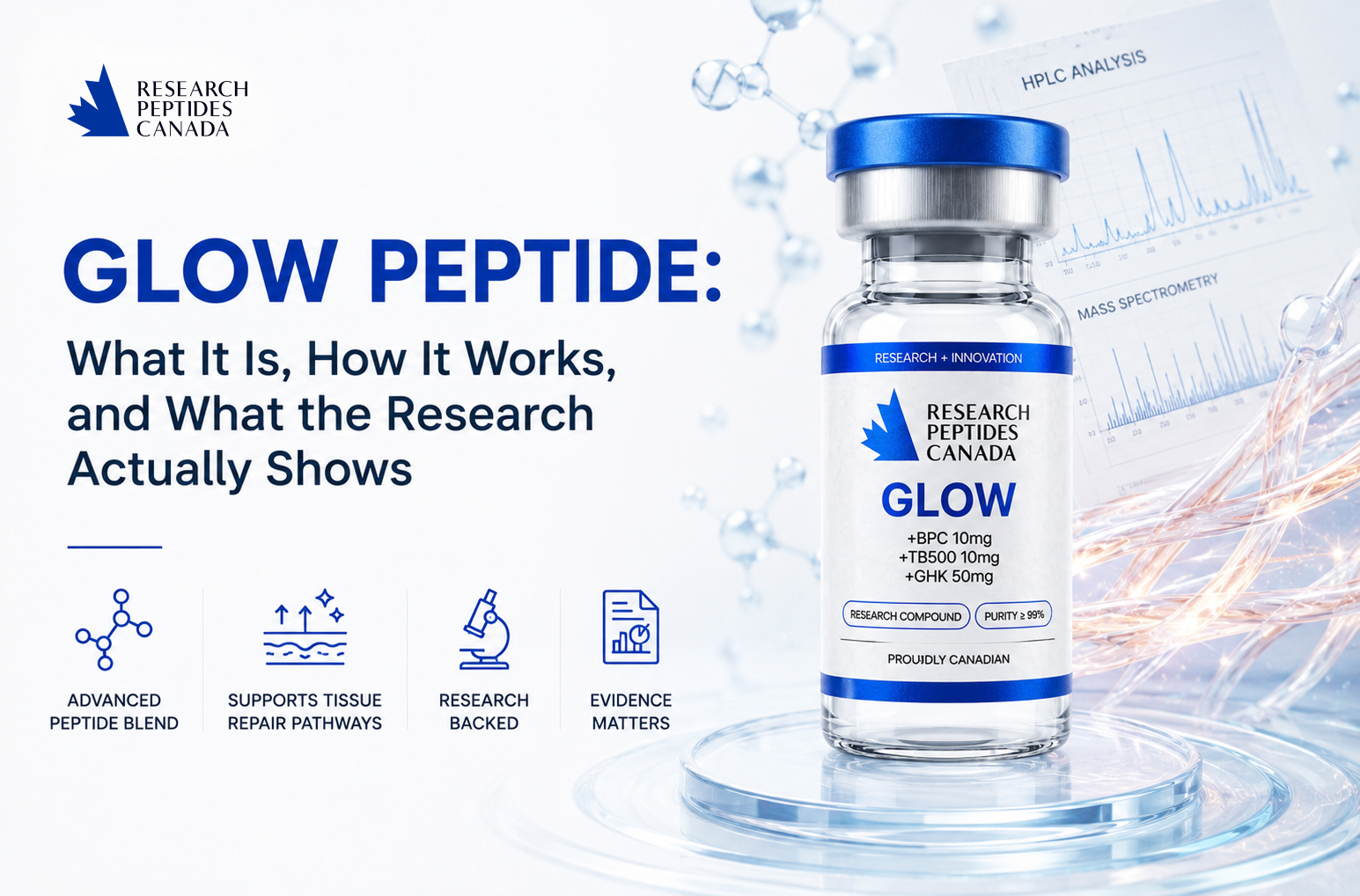


Interest in GLOW peptide has grown quickly because it brings together three widely discussed research compounds—BPC-157, TB-500, and GHK-Cu—within one experimental blend. The idea is straightforward: combine peptides associated with tissue repair, extracellular-matrix remodeling, angiogenesis, and skin biology, then investigate whether their effects overlap or complement one another.
However, the science is more nuanced than many online descriptions suggest. The individual ingredients have very different levels of evidence, and research on the complete combination remains limited.
If you are evaluating peptides for laboratory research, explore Research Peptides Canada for research-use-only compounds and product information. Analytical documentation, batch identity, purity, and published evidence should always be considered together.
What Exactly Is GLOW Peptide?
GLOW peptide is a research blend rather than a single naturally occurring peptide with its own established clinical literature. Formulations commonly combine three compounds:
- BPC-157
- TB-500
- GHK-Cu
That distinction matters.
A study involving BPC-157 does not automatically validate the complete blend. Likewise, findings involving TB-500, thymosin beta-4, or GHK-Cu cannot simply be combined and treated as proof that the three-compound formulation produces identical results.
BPC-157 is a synthetic 15-amino-acid peptide studied primarily in preclinical models involving tendon, ligament, gastrointestinal, vascular, and other forms of tissue injury. A 2025 review published in the biomedical literature concluded that BPC-157 has accumulated substantial preclinical evidence, although rigorous human clinical research remains extremely limited (PubMed, 2025).
TB-500 is generally described as a thymosin beta-4-related research compound. Importantly, a 2026 scoping review published in Applied Sciences found that most tissue-repair literature relates to full-length thymosin beta-4 rather than TB-500 itself. Direct TB-500 studies represented only a small portion of the available evidence (McGuire et al., 2026).
GHK-Cu is a copper complex formed from the naturally occurring tripeptide glycyl-L-histidyl-L-lysine. It has been investigated for fibroblast activity, collagen synthesis, extracellular-matrix remodeling, angiogenesis, and skin-repair mechanisms (PubMed).
So, when you look at GLOW peptide, it is more accurate to think of it as an experimental combination of three separate research areas rather than one clinically characterized compound.
Explore the GLOW Peptide Blend and review its research-use formulation and available product details.
Why Combine BPC-157, TB-500, and GHK-Cu?
The research rationale behind GLOW peptide is essentially pathway coverage.
Instead of investigating one biological process, researchers can examine several overlapping elements of tissue repair within the same experimental model.
BPC-157 research has explored vascular responses, fibroblast activity, angiogenesis, nitric-oxide-related pathways, and connective-tissue healing. In animal studies, researchers have investigated its effects on tendon and ligament recovery, including experimental Achilles tendon injury models (PubMed).
Thymosin beta-4-related research focuses on processes such as cell migration, angiogenesis, inflammatory regulation, cytoskeletal activity, and extracellular-matrix remodeling. However, researchers should be careful not to treat every thymosin beta-4 study as direct evidence for TB-500. The 2026 review by McGuire and colleagues specifically highlights this distinction (Applied Sciences, 2026).
GHK-Cu adds another area of interest. Research has associated this copper peptide with fibroblast proliferation, collagen production, elastin synthesis, antioxidant processes, angiogenesis, and matrix remodeling (PubMed).
On paper, these mechanisms appear complementary.
But complementary mechanisms do not automatically mean biological synergy.
A particularly relevant study published in 2026 directly compared BPC-157, TB-500, and their combination in rats following Achilles tendon injury. Both peptides influenced selected healing measurements, but the combination did not consistently outperform the individual compounds (Biçer et al., 2026).
That finding is important when evaluating GLOW peptide research. The central question should not simply be whether the ingredients sound compatible. Instead, researchers need to determine whether combining them produces measurable effects that are actually different from using each component individually.
How Is GLOW Peptide Supposed to Work?
The proposed mechanism of GLOW peptide can be viewed through three overlapping research areas.
Vascular and Cellular Responses
Successful tissue repair depends partly on blood supply, cell migration, and communication between damaged tissue and surrounding cells.
BPC-157 has repeatedly been associated with vascular and repair-related signaling in animal research. Meanwhile, thymosin beta-4 literature has explored angiogenesis, endothelial activity, cell migration, and cytoskeletal organization.
A review of thymosin beta-4 research has described its potential involvement in wound healing, angiogenesis, inflammation regulation, and cellular migration, although this should again not be interpreted as direct proof of equivalent TB-500 activity in humans (PMC).
Extracellular-Matrix Remodeling
Tendons, skin, and other connective tissues depend heavily on fibroblast behaviour, collagen organization, and controlled extracellular-matrix turnover.
GHK-Cu is particularly interesting in this area.
Experimental studies and reviews have associated GHK-Cu with collagen synthesis, fibroblast proliferation, matrix metalloproteinase regulation, elastin production, and multiple growth-factor-related pathways involved in tissue remodeling (PubMed).
Inflammatory and Oxidative Regulation
Tissue repair is not simply a matter of accelerating growth. Early inflammation has to be properly regulated before remodeling and maturation can occur.
BPC-157, thymosin-related compounds, and GHK-Cu have each been investigated in experimental systems involving inflammatory signaling, oxidative stress, or tissue recovery.
However, the quantity and quality of evidence differ significantly between the three compounds.
Therefore, the proposed mechanism of GLOW peptide makes it scientifically interesting as an experimental blend. It does not mean that the complete formulation has a clinically established mechanism of action.
Direct studies examining pharmacokinetics, interactions, stability, dose-response relationships, and the complete three-component combination are still needed.
What Does Current Research Say About the Ingredients?
The evidence becomes much clearer when each ingredient is considered separately.
BPC-157
Animal research remains the foundation of the BPC-157 literature.
One frequently cited rat Achilles tendon experiment investigated doses including 10 µg/kg and reported improvements in biomechanical, microscopic, and functional healing measures (PubMed).
Other animal studies have explored similar experimental dose ranges in ligament, muscle, gastrointestinal, vascular, and soft-tissue models.
Human evidence is dramatically smaller.
A 2025 review examining BPC-157 and musculoskeletal injury research concluded that although preclinical findings are extensive, adequately powered human trials remain absent. The authors therefore emphasized that BPC-157 should still be considered investigational (PubMed, 2025).
A small 2025 pilot study also examined intravenous BPC-157 administration in only two participants. Although studies like this can contribute preliminary safety observations, two participants are nowhere near enough to establish general safety, therapeutic effectiveness, or standardized human dosing (Lee & Burgess, 2025).
TB-500
This is where online discussions often move significantly faster than the published evidence.
A 2026 scoping review evaluated approximately 80 studies involving thymosin beta-4, TB-500, and related derivatives. Most of the available research investigated thymosin beta-4 rather than TB-500 itself.
The authors found that direct evidence surrounding TB-500 remained comparatively limited, while much of the human research focused on ocular, wound, skin, and soft-tissue applications involving thymosin-related compounds (McGuire et al., 2026).
However, a 2026 rat Achilles tendon study provides particularly useful preclinical data.
Researchers compared BPC-157 at 10 µg/kg/day, TB-500 at 60 µg/kg/day, the two compounds together, and a control group over four weeks.
TB-500 produced improvements in selected biomechanical and histological parameters. Yet the BPC-157 plus TB-500 group did not demonstrate a clear additional benefit over the individual compounds (Biçer et al., 2026).
That is a useful reminder that combining research peptides does not automatically produce stronger effects.
GHK-Cu
GHK-Cu has a longer history within skin biology and wound-healing research.
Published research has associated the copper peptide with fibroblast proliferation, collagen production, angiogenesis, extracellular-matrix remodeling, and tissue-repair signaling.
Earlier experimental work also found that GHK-Cu could influence collagen synthesis and extracellular-matrix behavior, helping establish the compound as an important subject in regenerative and dermatological research (PubMed).
Research has continued into modern delivery systems as well.
For example, a 2025 study investigated GHK-Cu incorporated into an experimental hydrogel designed to support infected wound healing (PubMed, 2025).
Taken together, the ingredients provide a reasonable mechanistic foundation for studying GLOW peptide, but the evidence does not establish equivalent therapeutic effects in humans.
Explore the GLOW Peptide Blend and review its research-use formulation and available product details.
What Do We Know About GLOW Peptide Dosing and Safety?
This is where you need to separate published experimental dosing from internet dosing trends.
There is currently no validated human dosing schedule for GLOW peptide, nor is there an established clinical dose for the three-compound combination.
Published doses should therefore be viewed as experimental parameters tied to a specific species, model, route of administration, and study duration—not as personal-use protocols.
For example:
| Compound | Published Experimental Example | Key Limitation |
|---|---|---|
| BPC-157 | 10 µg/kg/day | Rat Achilles tendon model |
| TB-500 | 60 µg/kg/day | Rat model; not validated for humans |
| BPC-157 + TB-500 | Same respective doses combined | No clear additive advantage |
| GHK-Cu | Variable concentrations across topical, hydrogel, and biomaterial studies | No standardized systemic human dose |
The BPC-157 and TB-500 values above come from the 2026 Achilles tendon experiment and should not be converted directly into human dosing recommendations (Biçer et al., 2026).
Dose translation across species is not linear. Route of administration, peptide stability, metabolism, exposure duration, and biological endpoint can all substantially change experimental outcomes.
Safety uncertainty also remains important.
The U.S. FDA has stated that available human safety information for BPC-157 is limited and has raised concerns involving immunogenicity, peptide impurities, and characterization of the active pharmaceutical ingredient.
The FDA has also cited limited or insufficient human safety information for injectable GHK-Cu and thymosin beta-4 fragment-related compounds such as TB-500 (FDA).
Therefore, any serious discussion of GLOW peptide dosing should identify the species, dose, administration route, duration, formulation, and endpoint being studied.
Without that context, a dosing number has very little scientific meaning.
Explore our related guides:
What Does the Evidence Still Not Tell Us About GLOW Peptide?
This is arguably the most important section.
There are currently no robust controlled human trials validating the complete GLOW peptide formulation.
Researchers still do not know whether combining BPC-157, TB-500, and GHK-Cu changes:
- Pharmacokinetics
- Peptide stability
- Tissue distribution
- Degradation
- Immunogenicity
- Copper availability
- Dose-response relationships
- Biological interactions between the three components
We also do not know the optimal ratio between BPC-157, TB-500, and GHK-Cu—or whether one fixed ratio makes biological sense across different experimental models.
Most importantly, individual evidence cannot simply be added together.
Three interesting research compounds do not automatically create one clinically proven blend.
The 2026 BPC-157 and TB-500 tendon study illustrates this particularly well. Although both compounds influenced selected measures of tendon repair, combining them did not generate the expected additive improvement (Biçer et al., 2026).
Adding GHK-Cu could theoretically change those outcomes, but until the complete three-component formulation is directly tested against individual controls, that remains a hypothesis rather than an established finding.
For researchers, this uncertainty is precisely what makes GLOW peptide scientifically interesting.
Future studies should define the formulation precisely, verify compound identity and purity, include individual-component control groups, test multiple concentrations, document administration routes, and clearly separate mechanistic observations from claims of therapeutic effectiveness.
If you are sourcing compounds for laboratory investigation, visit Research Peptides Canada to explore research-use-only peptides and available product information. The strongest research approach is always to combine verified laboratory materials, careful experimental design, and the latest peer-reviewed evidence.
Disclaimer: The information and products discussed on this website are intended strictly for laboratory research and educational purposes only. They are not intended for human or veterinary use, diagnosis, treatment, prevention, or any form of clinical application.
5 Comments
This was a really well-balanced overview of GLOW peptide, especially the distinction between the individual ingredients and the complete blend. I found the discussion about BPC-157 and TB-500 not necessarily showing additive benefits particularly interesting. Are there any ongoing studies looking specifically at the full BPC-157, TB-500, and GHK-Cu combination?
This was a helpful overview, especially the section on TB-500 versus the existing thymosin beta-4 research. I think that distinction is often overlooked online. Do you think future studies will focus more on the exact GLOW formulation rather than extrapolating results from the individual compounds?
I liked that the article was careful not to present experimental dosing as a human-use recommendation. The lack of controlled human studies on the complete BPC-157, TB-500, and GHK-Cu combination seems like one of the biggest gaps in the current research. It would be interesting to see how researchers design future studies to address that.