
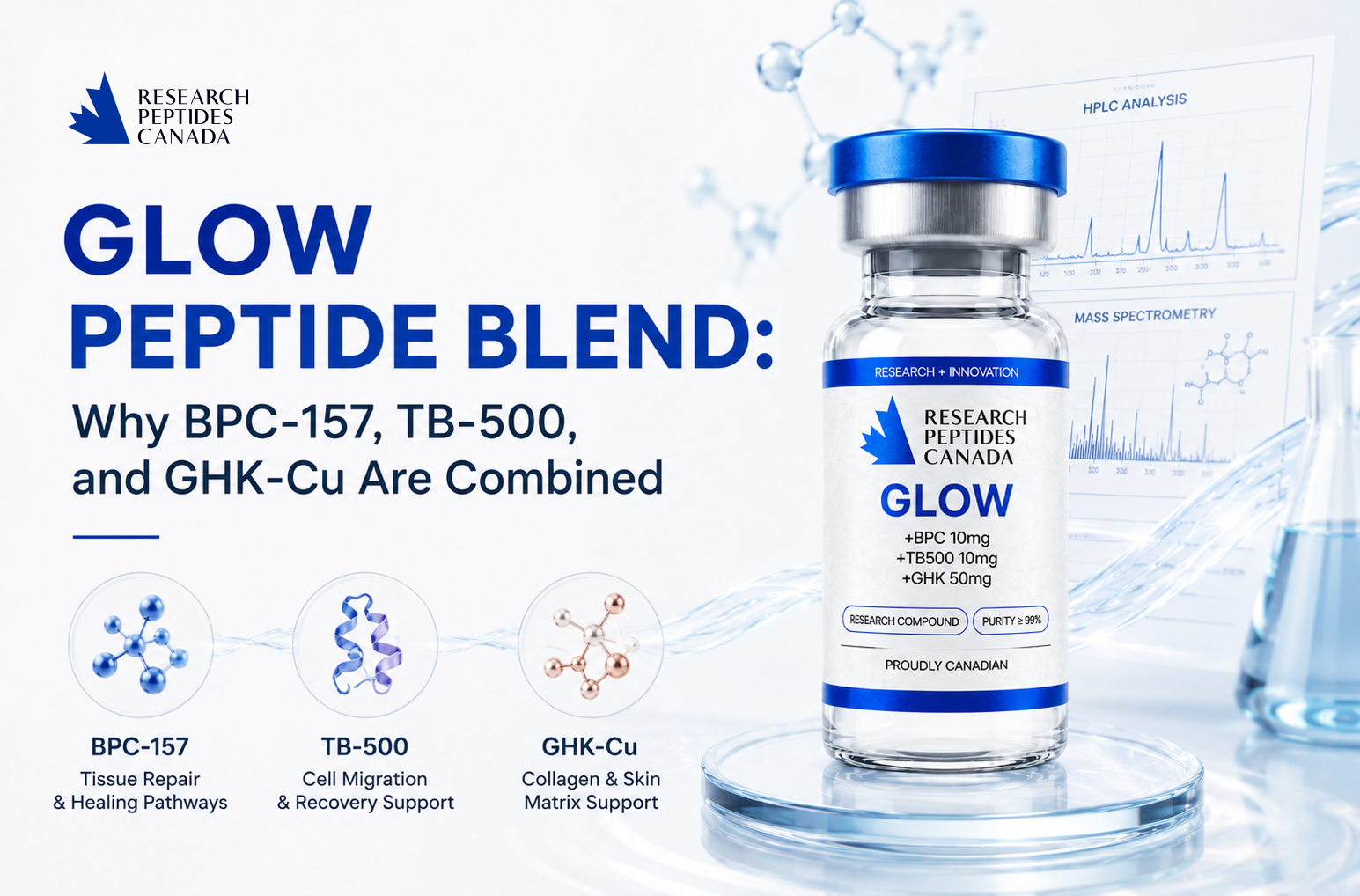


The GLOW peptide blend is more interesting as a formulation question than as another list of peptide “benefits.”
Why put BPC-157, TB-500, and GHK-Cu in the same formulation? Does the ratio matter? Could the ingredients reinforce—or interfere with—one another? And perhaps most importantly, does testing three raw peptides separately tell you anything about the stability of the finished blend?
Those are the questions that matter if you are looking at GLOW from a research perspective.
If you are evaluating multi-peptide materials for laboratory investigation, explore Research Peptides Canada for research-use-only compounds and available product information. With a blend, researchers should look beyond the total milligram number and examine component identity, ratio, finished-product testing, and stability data.
What Is Actually Inside the GLOW Peptide Blend?
The GLOW peptide blend generally refers to a co-formulation of three chemically different research peptides:
- BPC-157 — a synthetic 15-amino-acid peptide.
- TB-500 — a shorter peptide associated with the thymosin beta-4 research family.
- GHK-Cu — a copper(II)-coordinated tripeptide composed of glycyl-L-histidyl-L-lysine.
Calling this a “blend” is important because GLOW is not a new single molecule. Each component retains its own structure, molecular mass, chemical behaviour, and research history.
BPC-157 alone already presents formulation questions. In a 2026 review published in Pharmaceutics, Mateescu and colleagues concluded that BPC-157 lacks a validated pharmaceutical formulation, formal excipient-compatibility studies, and sufficiently characterized human pharmacokinetics. That matters here because if one ingredient is incompletely characterized as a standalone formulation, combining it with two additional compounds introduces even more variables. (Mateescu et al., 2026 – Pharmaceutics)
TB-500 requires another distinction. A 2026 scoping review by McGuire et al. in Applied Sciences identified 80 repair-related studies involving thymosin beta-4, TB-500, or related derivatives, but most examined full-length thymosin beta-4. Direct TB-500 evidence was extremely limited. (McGuire et al., 2026 – Applied Sciences)
GHK-Cu adds something neither of the other ingredients contains: a coordinated metal ion. Its chemical identity therefore depends not simply on a peptide sequence but on the copper-peptide complex itself.
That difference becomes particularly relevant when we move from composition to co-formulation.
Explore the GLOW Peptide Blend and review its research-use formulation and available product details.
Why Are BPC-157, TB-500, and GHK-Cu Combined?
The rationale behind the GLOW peptide blend is pathway coverage rather than chemical similarity.
BPC-157 is commonly investigated in connective-tissue, vascular, and repair-related models. TB-500 is associated with a literature involving cell migration and matrix remodeling, although researchers need to distinguish direct TB-500 findings from thymosin beta-4 data. GHK-Cu contributes another body of work involving extracellular-matrix biology, collagen, angiogenesis, and dermal delivery.
The combination therefore attempts to place several research directions into one formulation:
| Component | Formulation Rationale |
|---|---|
| BPC-157 | Connective-tissue and vascular research |
| TB-500 | Cell migration and remodeling research |
| GHK-Cu | Copper-peptide, collagen, and matrix research |
GHK-Cu is particularly different from the other two components. In a 2025 review in BioImpacts, Mortazavi and colleagues discussed GHK/GHK-Cu research involving tissue regeneration, collagen and glycosaminoglycan synthesis, angiogenesis, and dermal applications, while also pointing out major gaps in physicochemical and permeability data. (Mortazavi et al., 2025 – BioImpacts)
Researchers are also actively investigating engineered delivery systems rather than simply free peptide solutions. For example, Chen et al. reported in Biomaterials Research in 2025 that GHK-Cu could be incorporated into a self-healing hydrogel designed to provide sustained local delivery in experimental wound models. (Chen et al., 2025 – Biomaterials Research)
That study is useful for understanding the formulation issue: how a peptide is formulated can influence its experimental behaviour.
For the GLOW peptide blend, therefore, simply knowing which three ingredients are present is only the starting point.
Does the Ratio Between the Three Peptides Matter?
This is one of the biggest differences between discussing GLOW as a blend and discussing the individual peptides.
There is currently no peer-reviewed standardized GLOW ratio established through dose-response studies of the complete three-component formulation.
That means two materials sold under the same GLOW peptide blend name could theoretically contain substantially different proportions of BPC-157, TB-500, and GHK-Cu.
A total such as “50 mg” or “70 mg” also tells you relatively little unless you know exactly how that total is divided.
For example: 70 mg total peptide does not mean 70 mg of each ingredient.
From an experimental-design standpoint, researchers need the amount of each constituent because the ratio determines relative exposure.
It is also inappropriate to derive a blend ratio simply by taking doses from unrelated studies.
A useful example comes from the 2026 Achilles tendon study by Biçer et al. in Joint Diseases and Related Surgery. Researchers tested BPC-157 at 10 µg/kg/day and TB-500 at 60 µg/kg/day in rats, both separately and together. (Biçer et al., 2026 – Joint Diseases and Related Surgery)
Those numbers describe a specific animal model, administration route, and research endpoint. They do not establish an ideal BPC-157:TB-500 ratio for a lyophilized blend, and they provide no information about how much GHK-Cu should be added.
In fact, the same experiment produced an important result for formulation thinking: combining BPC-157 and TB-500 did not generate a clear additive advantage over the individual compounds. (PubMed)
So “more ingredients” does not necessarily mean “more biological effect.”
For researchers, the ratio itself should therefore be treated as an experimental variable—not as a scientifically established constant.
Explore the GLOW Peptide Blend and review its research-use formulation and available product details.
How Could Peptide Interactions and Stability Affect the Blend?
This is where the GLOW peptide blend becomes a genuine formulation problem.
Peptides can be affected by factors including:
- pH
- oxidation
- hydrolysis
- temperature
- light
- storage duration
- repeated freeze-thaw exposure
- concentration
- excipients
- interactions with other molecules in solution
BPC-157 formulation science is still incomplete. The 2026 Mateescu et al. review specifically noted the lack of formal excipient-compatibility studies and validated pharmaceutical preparations for BPC-157 itself. (Mateescu et al., 2026 – Pharmaceutics)
GHK-Cu introduces additional complexity because its properties depend on coordination between GHK and copper.
A physicochemical pre-formulation study of GHK-Cu found that the compound was susceptible to degradation under oxidative and alkaline stress, while its stability differed depending on formulation components. Researchers used stability-indicating HPLC and mass spectrometry to identify degradation products. (GHK-Cu physicochemical and stability study)
More recent research reinforces the importance of formulation.
In 2025, Ogórek et al. published a review in Molecules examining GHK-Cu delivery and skin permeation. They described GHK-Cu as highly hydrophilic and highlighted how little is still known about its transport when incorporated into delivery systems such as liposomes. (Ogórek et al., 2025 – Molecules)
These studies do not prove that GHK-Cu is incompatible with BPC-157 or TB-500.
Instead, they demonstrate why compatibility cannot simply be assumed.
There is an important distinction:
Stability data for three peptides individually are not the same as stability data for the finished three-peptide formulation.
A proper stability study of the complete GLOW peptide blend would ideally investigate whether each component remains chemically intact over time under defined storage conditions, rather than measuring only total peptide content.
Researchers would also want to know whether degradation products increase after reconstitution and whether the presence of copper changes the behaviour of either accompanying peptide.
At present, those questions remain largely unanswered for the complete blend.
For a broader overview of the formulation, read our guide: GLOW Peptide: What It Is, How It Works, and What the Research Actually Shows.
What Should Researchers Verify in a GLOW Peptide Blend?
Because GLOW contains multiple components, quality assessment needs to go further than a single headline purity percentage.
1. Exact Composition
Researchers should first confirm that the formulation actually contains:
- BPC-157
- TB-500
- GHK-Cu
The exact amount of each component should also be documented.
2. Component Ratio
A certificate showing only total vial content does not fully characterize a blend.
For reproducibility, the individual BPC-157:TB-500:GHK-Cu ratio should be known and consistent between batches.
3. Molecular Identity
Analytical methods such as mass spectrometry can help support peptide identity.
This is especially important for TB-500 because the 2026 McGuire et al. review demonstrated how frequently TB-500 and thymosin beta-4 literature become mixed together despite being distinct research materials. (McGuire et al., 2026 – Applied Sciences)
4. Chromatographic Purity
HPLC can provide information about chromatographic purity and related impurities, but researchers should ask whether the method can adequately resolve the components and relevant degradation products in a multi-peptide sample.
A generic “99% purity” statement is less useful if the analytical method and tested material are unclear.
5. Finished-Blend Testing
This may be the most overlooked point.
Testing BPC-157, TB-500, and GHK-Cu as three raw materials before blending is not equivalent to testing the finished GLOW peptide blend.
Finished-product testing can help answer different questions:
- Are all three compounds still identifiable after formulation?
- Does the intended ratio remain correct?
- Are unexpected peaks present?
- Are degradation products detectable?
- Is batch-to-batch composition consistent?
6. Stability Conditions
Storage claims should ideally be supported by actual stability data for the finished formulation.
Researchers should distinguish between:
- lyophilized stability;
- reconstituted stability;
- short-term versus longer-term storage;
- temperature-controlled versus room-temperature exposure.
This becomes particularly important because existing GHK-Cu research demonstrates that oxidative environment and formulation composition can influence stability. (GHK-Cu pre-formulation stability research)
Ultimately, the GLOW peptide blend should not be evaluated simply by adding together everything known about BPC-157, TB-500, and GHK-Cu.
The more useful research questions are whether the chosen composition makes sense, whether the ratio is defined, whether the components remain compatible, and whether the finished formulation has actually been analytically characterized.
That is also where the biggest evidence gap remains. Current literature provides useful constituent-level information and one particularly relevant BPC-157/TB-500 combination study, but controlled research on the complete three-component formulation remains absent from the peer-reviewed evidence identified for this review. The lack of additive benefit in the 2026 BPC-157/TB-500 experiment is a useful reminder that a plausible combination still needs to be tested directly. (PubMed)
If you are comparing research materials, visit Research Peptides Canada to explore research-use-only peptide products and available documentation. For a GLOW peptide blend, prioritize transparent composition, defined ratios, batch-specific identity and purity testing, and—where available—analytical data generated from the finished formulation rather than assumptions based only on its individual ingredients.
Disclaimer: The information and products discussed on this website are intended strictly for laboratory research and educational purposes only. They are not intended for human or veterinary use, diagnosis, treatment, prevention, or any form of clinical application.
4 Comments
I really liked the formulation-focused approach of this article. The point that testing each peptide separately doesn’t necessarily tell us how stable the finished blend will be is something I hadn’t considered before. Would finished-blend stability testing become a standard requirement for multi-peptide formulations in the future?
The section about the ratio between BPC-157, TB-500, and GHK-Cu was particularly interesting. I agree that simply knowing the total milligram amount doesn’t provide much information without knowing the individual proportions. I’d be interested to know how researchers could determine an appropriate ratio experimentally rather than relying on data from separate studies.
This was a great reminder that a “99% purity” claim doesn’t necessarily tell the whole story for a multi-peptide blend. I especially liked the discussion around molecular identity, HPLC, and finished-product testing. Do you think batch-specific testing should be considered just as important as the initial purity results?