
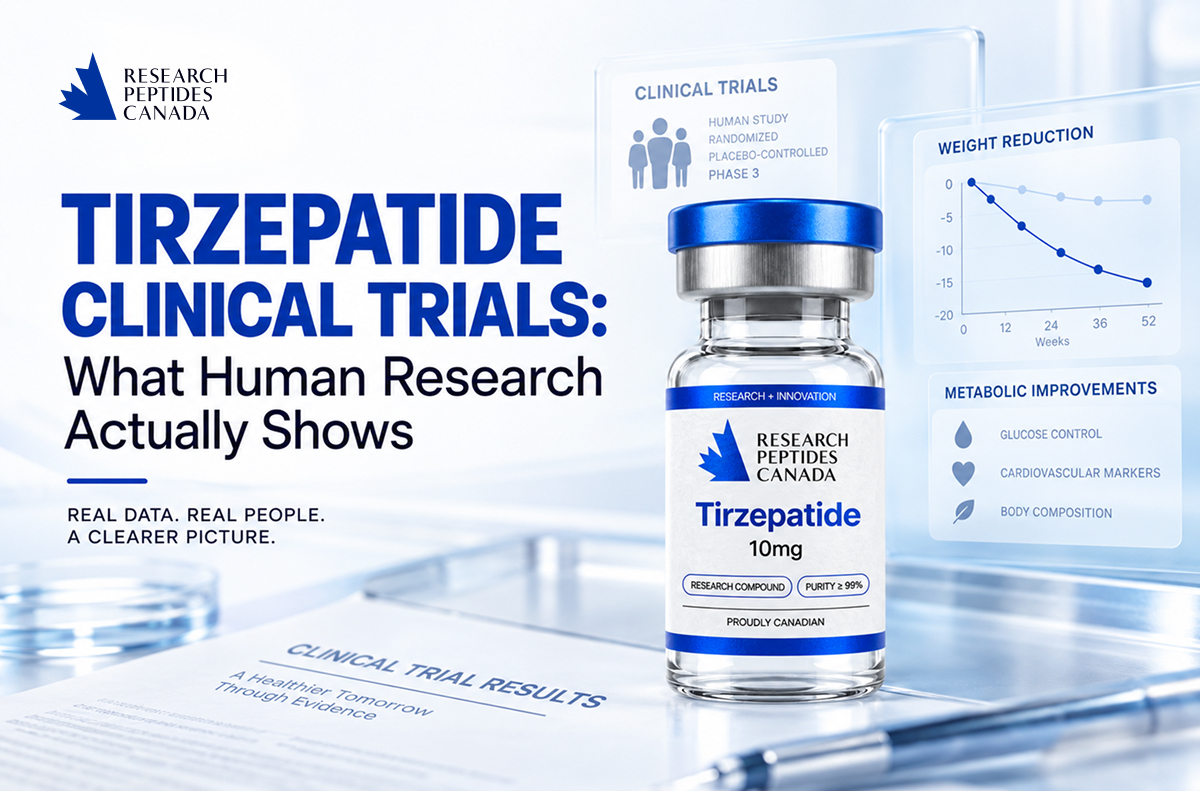


The field of Tirzepatide clinical trials represents one of the most significant developments in modern metabolic research.
Unlike earlier incretin-based therapies that primarily focused on GLP-1 receptor activation, tirzepatide was designed as a dual GIP and GLP-1 receptor agonist.
Human trials have investigated whether this combined approach can improve:
- blood glucose regulation;
- body-weight reduction;
- metabolic risk factors;
- long-term health outcomes.
The strongest evidence currently comes from two major clinical programs:
- SURPASS trials, which studied adults with type 2 diabetes.
- SURMOUNT trials, which studied adults with obesity or overweight with weight-related conditions.
These studies have demonstrated substantial improvements in glycemic control and body weight. However, researchers continue investigating long-term outcomes, durability after treatment discontinuation, and the contribution of individual incretin pathways.
If you are exploring metabolic peptide research, visit Research Peptides Canada to review research-use-only compounds and available documentation.
What Have Tirzepatide Clinical Trials Been Designed to Study?
The main goal of Tirzepatide clinical trials has been to evaluate how dual GIP and GLP-1 receptor activation influences metabolic health.
Researchers designed these studies around several major questions:
- Can tirzepatide improve glucose control in adults with type 2 diabetes?
- Can it produce meaningful weight reduction in people with obesity?
- How does it compare with existing incretin-based treatments?
- What safety signals appear with longer-term exposure?
The first major clinical development program was SURPASS, which focused on adults with type 2 diabetes.
These trials evaluated tirzepatide as:
- an addition to lifestyle intervention;
- an alternative to other glucose-lowering medications;
- a comparison against established therapies.
The SURMOUNT program later expanded research into obesity.
Unlike diabetes trials, SURMOUNT studies examined whether tirzepatide could produce significant weight reduction in adults without diabetes.
The design of these programs reflects a broader shift in metabolic research.
Rather than treating glucose regulation and body weight as separate problems, researchers increasingly recognize that obesity, insulin resistance, and metabolic dysfunction are interconnected.
Interested in exploring this compound further? Visit our Tirzepatide 10mg page for more research information.
What Have Clinical Trials Found About Tirzepatide and Body Weight?
One of the most studied outcomes in Tirzepatide clinical trials is body-weight reduction.
The largest evidence comes from the SURMOUNT-1 trial.
This Phase 3 randomized controlled trial evaluated tirzepatide in 2,539 adults with obesity or overweight plus at least one weight-related condition, excluding people with diabetes.
Participants received weekly tirzepatide doses of:
- 5 mg;
- 10 mg;
- 15 mg;
for 72 weeks.
Researchers found substantial reductions in body weight compared with placebo.
Average weight reductions were:
- 15.0% with 5 mg;
- 19.5% with 10 mg;
- 20.9% with 15 mg.
The placebo group experienced approximately 3.1% weight reduction.
(Jastreboff et al., 2022, New England Journal of Medicine)
These results made tirzepatide one of the most extensively studied pharmacological approaches for obesity.
However, researchers emphasize that weight reduction involves multiple mechanisms.
Clinical evidence suggests contributions from:
- reduced appetite;
- lower energy intake;
- delayed gastric emptying;
- improved metabolic signaling.
A body-composition analysis from SURMOUNT-1 found that approximately three-quarters of weight loss came from fat mass reduction, while the remainder came from reductions in lean mass.
(Heymsfield et al., 2024, The Lancet Diabetes & Endocrinology)
This finding is important because changes in body composition provide additional information beyond the number shown on a scale.
Weight Maintenance After Treatment
A major research question is whether weight reduction continues after stopping treatment.
The SURMOUNT-4 trial examined this issue.
Participants first received tirzepatide for 36 weeks and were then randomized to continue treatment or switch to placebo.
Researchers found that participants who continued tirzepatide maintained additional weight reduction, while those switched to placebo experienced weight regain.
This suggests that ongoing metabolic signaling may be important for maintaining weight-related effects.
What Does Research Show About Tirzepatide and Glycemic Control?
Another major focus of Tirzepatide clinical trials is glucose regulation.
The SURPASS program evaluated tirzepatide in adults with type 2 diabetes across different treatment backgrounds.
Researchers consistently found improvements in:
- HbA1c reduction;
- fasting glucose;
- body weight.
One of the most important comparisons came from SURPASS-2.
This trial directly compared tirzepatide with semaglutide 1 mg weekly in adults with type 2 diabetes inadequately controlled with metformin.
The study included 1,879 participants.
Researchers found that all tirzepatide doses produced greater reductions in HbA1c compared with semaglutide.
Body-weight reduction was also greater with tirzepatide.
(Frías et al., 2021, New England Journal of Medicine)
These findings support the idea that activating both GIP and GLP-1 receptors may produce stronger metabolic effects than GLP-1 receptor activation alone.
Effects on Insulin and Glucose Pathways
Tirzepatide improves glucose control through several mechanisms:
- increasing glucose-dependent insulin secretion;
- reducing inappropriate glucagon release;
- improving insulin sensitivity;
- reducing body weight.
The SURPASS trials showed that improvements in HbA1c were maintained over extended treatment periods.
However, researchers continue studying whether these improvements translate into reduced long-term diabetes complications.
How Does Tirzepatide Compare With Other Incretin-Based Treatments in Trials?
Comparative research has been a major component of tirzepatide clinical trials.
The most notable comparison has been with semaglutide.
Tirzepatide vs Semaglutide
SURPASS-2 provided direct evidence comparing tirzepatide with semaglutide.
The trial showed:
- greater HbA1c reductions with tirzepatide;
- greater average weight reduction with tirzepatide.
However, both treatments demonstrated strong metabolic effects.
Tirzepatide vs Insulin
SURPASS-3 compared tirzepatide with insulin degludec in adults with type 2 diabetes inadequately controlled on metformin.
After 52 weeks:
- tirzepatide produced greater HbA1c reductions;
- participants experienced weight reduction rather than weight gain.
(Ludvik et al., 2021, The Lancet)
Tirzepatide vs Dulaglutide
The SURPASS-CVOT trial was designed to compare tirzepatide with dulaglutide in adults with type 2 diabetes and increased cardiovascular risk.
The purpose is to determine whether differences in metabolic effects translate into differences in cardiovascular outcomes.
Long-term outcome trials are especially important because improvements in biomarkers do not always guarantee improvements in major health events.
Interested in exploring this compound further? Visit our Tirzepatide 10mg page for more research information.
What Safety Findings and Research Gaps Have Tirzepatide Trials Identified?
Safety has been a central component of Tirzepatide clinical trials.
Across studies, the most commonly reported adverse effects were gastrointestinal, including:
- nausea;
- diarrhea;
- vomiting;
- constipation.
These effects were generally more common during dose escalation.
The FDA prescribing information includes warnings related to:
- thyroid C-cell tumors observed in animal studies;
- pancreatitis;
- gallbladder disease;
- kidney injury related to dehydration;
- hypoglycemia risk when combined with insulin or insulin secretagogues.
(U.S. FDA Tirzepatide Prescribing Information)
Remaining Research Questions
Although evidence is extensive, researchers continue investigating:
Long-Term Cardiovascular Outcomes
The effect of tirzepatide on major cardiovascular events remains an important research area.
Durability After Discontinuation
Clinical trials suggest weight regain may occur after stopping treatment, but researchers continue studying long-term management strategies.
Broader Metabolic Applications
Researchers are investigating potential effects on:
- metabolic dysfunction-associated steatotic liver disease;
- sleep apnea related to obesity;
- cardiovascular risk reduction.
Research Dosing
Clinical trials have evaluated weekly doses from 5 mg to 15 mg depending on study design.
For example, SURMOUNT-1 studied 5 mg, 10 mg, and 15 mg weekly doses over 72 weeks.
These values represent controlled clinical research protocols and should not be interpreted as general dosing recommendations.
Learn more in our complete guide: What Is Tirzepatide? What Current Research and Clinical Evidence Show.
FAQ About Tirzepatide Clinical Trials
What were tirzepatide clinical trials designed to study?
They were designed to evaluate glucose control, weight reduction, safety, and metabolic outcomes in adults with type 2 diabetes or obesity.
How much weight loss was reported in trials?
SURMOUNT-1 reported average weight reductions of up to approximately 20.9% with the highest studied dose over 72 weeks. (Jastreboff et al., 2022)
Did tirzepatide improve diabetes control?
Yes. SURPASS trials demonstrated significant HbA1c reductions in adults with type 2 diabetes.
How does tirzepatide compare with semaglutide?
SURPASS-2 found greater average HbA1c and weight reductions with tirzepatide compared with semaglutide 1 mg weekly.
Are tirzepatide effects maintained after stopping treatment?
Evidence from SURMOUNT-4 suggests some weight regain occurs after discontinuation.
What is the biggest limitation of current tirzepatide research?
The biggest remaining questions involve long-term outcomes, durability, and broader applications beyond current approved uses.
Overall, Tirzepatide clinical trials provide some of the strongest human evidence in modern incretin-based metabolic research.
Large randomized studies demonstrate significant improvements in glucose control and body weight, while comparative trials show meaningful differences between tirzepatide and several established therapies.
At the same time, ongoing research is needed to understand long-term outcomes, treatment durability, and the full biological impact of dual GIP and GLP-1 receptor activation.
For laboratory-focused peptide research, visit Research Peptides Canada to explore research-use-only compounds and available documentation.
Disclaimer: The information and products discussed on this website are intended strictly for laboratory research and educational purposes only. They are not intended for human or veterinary use, diagnosis, treatment, prevention, or any form of clinical application.
3 Comments
I liked how the clinical trials provide a clearer picture of tirzepatide beyond the basic GIP and GLP-1 mechanism. The consistency of the results across different trial populations is interesting, although differences in study design and patient characteristics are still important when comparing outcomes.
The longer-term trial data caught my attention because short-term weight loss doesn’t tell the whole story with a treatment like tirzepatide. I’d be interested in seeing more research on how weight, metabolic markers, and body composition change over several years rather than just during the main trial period.
One thing I appreciated was the focus on both benefits and limitations in the clinical evidence. The results are impressive, but questions around maintaining the effects after discontinuation and understanding long-term safety seem just as important as the initial weight-loss numbers.