


Interest in Retatrutide peptide has accelerated as research moves beyond early metabolic studies into large Phase 3 clinical trials. Unlike traditional GLP-1 receptor agonists, retatrutide is designed to activate three metabolic receptors at once: GIP, GLP-1, and glucagon.
That makes the compound scientifically interesting, but it also means you need to separate established trial data from assumptions based on its mechanism.
If you are evaluating peptides for laboratory research, explore Research Peptides Canada for research-use-only compounds and available product information. As with any investigational peptide, current clinical evidence, analytical quality, and regulatory status should all be considered together.
What Exactly Is Retatrutide Peptide?
Retatrutide peptide, originally identified as LY3437943, is an investigational triple hormone receptor agonist developed by Eli Lilly. A single molecule activates the glucose-dependent insulinotropic polypeptide receptor (GIPR), glucagon-like peptide-1 receptor (GLP-1R), and glucagon receptor (GCGR).
The scientific foundation was described by Coskun and colleagues in a 2022 study published in Cell Metabolism. The researchers found that LY3437943 displayed activity at all three receptors, with greater activity at GIP receptors while maintaining GLP-1 and glucagon receptor agonism. In obese mouse models, the compound reduced body weight and improved glucose regulation. (ScienceDirect)
The molecule was also engineered with pharmacokinetic characteristics supporting once-weekly administration in clinical research.
However, an important distinction remains: retatrutide is still investigational.
As of August 2026, it has not completed the regulatory approval process. Lilly reported in July 2026 that it plans to submit a Biologics License Application to the U.S. FDA in the first quarter of 2027. (Eli Lilly and Company)
So, although Retatrutide peptide now has substantial human clinical data behind it, it should not yet be discussed as an approved therapy.
Why Is Retatrutide Different From Earlier Incretin-Based Compounds?
The main difference comes down to receptor coverage.
Traditional GLP-1 compounds primarily target the GLP-1 receptor. Dual agonists such as tirzepatide expand that concept by activating both GIP and GLP-1 receptors.
Retatrutide adds glucagon receptor activation.
Researchers are interested in this third pathway because glucagon signaling is involved not only in hepatic glucose regulation but also in lipid metabolism, amino-acid metabolism, satiety, and energy expenditure.
The 2022 Cell Metabolism research by Coskun et al. suggested that combining GIP and GLP-1 signaling with glucagon receptor agonism could produce metabolic effects beyond those generated by incretin activity alone. In experimental models, the triple agonist produced substantial body-weight reductions while maintaining glycemic improvements. (ScienceDirect)
However, this does not mean glucagon receptor activation simply makes Retatrutide peptide “stronger.”
The scientific question is whether the balance among all three receptors changes energy intake, energy expenditure, glucose regulation, and lipid metabolism in a beneficial and sustainable way.
That receptor balance remains an active area of research.
For more research-focused information, explore our Retatrutide research peptide and review the available product details.
How Does Retatrutide Target GLP-1, GIP, and Glucagon Receptors?
You can think of the proposed mechanism as three connected metabolic signals.
GLP-1 Receptor Activity
GLP-1 signaling supports glucose-dependent insulin secretion, influences glucagon secretion, slows gastric emptying, and contributes to appetite and food-intake regulation.
These mechanisms already have extensive clinical research behind them.
GIP Receptor Activity
GIP also stimulates insulin secretion in a glucose-dependent manner and participates in nutrient and lipid metabolism.
Combining GIP with GLP-1 signaling has become an important area of metabolic research because the pathways can interact rather than simply duplicate one another.
Glucagon Receptor Activity
This is what makes Retatrutide peptide especially distinctive.
Glucagon can increase hepatic glucose output, but glucagon-receptor activation has also been investigated for effects on energy expenditure, fat oxidation, lipid metabolism, amino-acid metabolism, and satiety.
The challenge is achieving those potential metabolic effects without losing glucose control.
That balance appears possible because retatrutide simultaneously activates GIP and GLP-1 pathways.
A 2023 New England Journal of Medicine editorial discussing the Phase 2 retatrutide data highlighted this triple-receptor approach as a possible explanation for the unusually large weight reductions observed in early trials. (New England Journal of Medicine)
Still, the precise contribution of each receptor remains difficult to isolate in humans because the molecule activates all three simultaneously.
What Have Retatrutide Clinical Trials Shown So Far?
This is where the evidence has changed significantly.
Phase 2 Obesity Research
In 2023, Jastreboff et al. published a randomized Phase 2 obesity trial in the New England Journal of Medicine involving 338 adults with obesity or overweight plus at least one weight-related condition.
At 48 weeks, average body-weight changes were:
| Weekly Study Dose | Mean Weight Change |
|---|---|
| 1 mg | -8.7% |
| 4 mg | -17.1% |
| 8 mg | -22.8% |
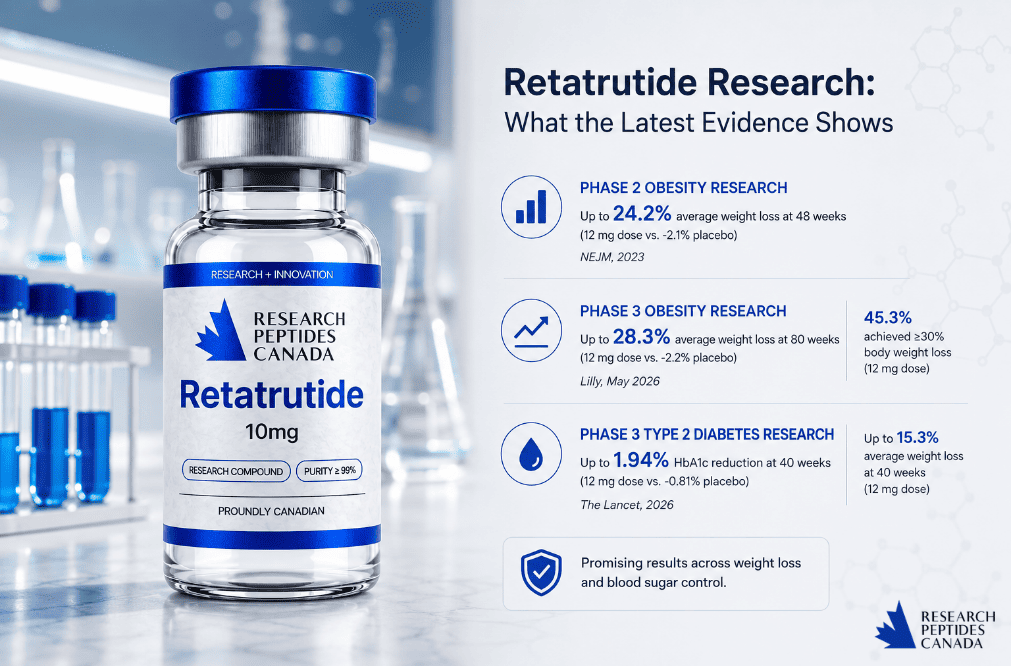
| 12 mg | -24.2% |
| Placebo | -2.1% |
Importantly, participants receiving the highest doses were still losing weight when the 48-week study ended, suggesting that a weight-loss plateau had not yet clearly occurred. (New England Journal of Medicine)
Phase 3 Obesity Research
The research picture became considerably stronger in 2026.
In May 2026, Lilly reported topline results from TRIUMPH-1, a Phase 3 trial involving 2,339 adults with obesity or overweight without diabetes.
At 80 weeks, the efficacy estimand showed average weight reductions of 19.0% with 4 mg, 25.9% with 9 mg, and 28.3% with 12 mg, compared with 2.2% with placebo. Among participants receiving 12 mg, 45.3% achieved at least 30% body-weight reduction. (Eli Lilly and Company)
Participants with a baseline BMI of at least 35 who continued into a 104-week extension achieved an average weight reduction of 30.3% with the 12 mg regimen.
These are major findings, although you should note that the complete TRIUMPH-1 results had not yet been published as a full peer-reviewed journal article at the time of writing.
Phase 3 Type 2 Diabetes Research
More importantly, peer-reviewed Phase 3 evidence is now available.
In June 2026, Bajaj et al. published TRANSCEND-T2D-1 in The Lancet. The randomized trial included 537 adults with type 2 diabetes inadequately controlled through diet and exercise.
At week 40, mean HbA1c reductions were:
- 1.69 percentage points with 4 mg
- 1.86 percentage points with 9 mg
- 1.94 percentage points with 12 mg
- 0.81 percentage points with placebo
Body-weight reductions reached 11.5%, 13.9%, and 15.3% across the three Retatrutide peptide groups, compared with 2.6% with placebo. (PubMed)
Then, in July 2026, Lilly reported additional Phase 3 results from TRIUMPH-2 and TRIUMPH-3.
TRIUMPH-2 reported weight reductions of up to 20.8% at 80 weeks in adults with obesity or overweight and type 2 diabetes. TRIUMPH-3 reported reductions of up to 22.6% among adults with severe obesity and established cardiovascular disease. These remain company-reported topline results pending full peer-reviewed publication. (Eli Lilly and Company)
For more research-focused information, explore our Retatrutide research peptide and review the available product details.
What Do We Know About Dosing, Results, and Side Effects?
Clinical trial dosing should not be confused with online dosing advice. Retatrutide peptide remains investigational, so there is currently no approved consumer dosing schedule.
Trials have evaluated several once-weekly target doses:
| Research Program | Studied Doses | Duration |
|---|---|---|
| Phase 2 obesity trial | 1, 4, 8, 12 mg | 48 weeks |
| TRANSCEND-T2D-1 | 4, 9, 12 mg | 40 weeks |
| TRIUMPH-1 | 4, 9, 12 mg | 80 weeks |
In the Phase 2 obesity trial, Jastreboff et al. reported that gastrointestinal effects were the most common adverse events and generally increased with dose. A lower starting dose helped reduce some of these effects. Temporary dose-related increases in heart rate were also observed. (New England Journal of Medicine)
TRIUMPH-1 used gradual dose escalation. Participants began at 2 mg once weekly, with doses increased every four weeks until the assigned maintenance dose was reached. This was a clinical-trial protocol, not a self-administration recommendation. (Eli Lilly and Company)
At 12 mg in TRIUMPH-1, Lilly reported nausea in 42.4% of participants, diarrhea in 32.0%, constipation in 26.1%, and vomiting in 25.3%. Treatment discontinuation related to adverse events occurred in 11.3%.
Similarly, the 2026 TRANSCEND-T2D-1 trial published in The Lancet found that gastrointestinal events were usually mild to moderate and often decreased over time. Approximately 2–5% of retatrutide participants discontinued treatment because of adverse events, and no severe hypoglycemia was reported. (PubMed)
For that reason, discussions of Retatrutide peptide dosing should always consider the target dose, escalation schedule, study population, trial duration, and safety findings rather than presenting one dose as universally appropriate.
Explore our related guides:
What Questions About Retatrutide Are Researchers Still Trying to Answer?
Despite increasingly strong clinical data, several questions about retatrutide remain open. Researchers are still studying long-term cardiovascular and kidney outcomes, weight maintenance after treatment, body-composition changes, gastrointestinal tolerability, optimal dose escalation, and the role of glucagon receptor activation.
Body composition is one important area. A 2025 Phase 2 substudy by Coskun et al. found that retatrutide significantly reduced total fat mass in participants with type 2 diabetes. Lean-mass loss as a proportion of total weight loss was broadly comparable with other obesity treatments. (PubMed)
Long-term cardiovascular and renal outcomes are also being investigated. Health Canada’s clinical-trial database lists TRIUMPH-Outcomes, a large Phase 3 study evaluating cardiovascular and kidney outcomes in adults with obesity and cardiovascular disease and/or chronic kidney disease. (Clinical Trials Canada)
Canadian trial listings also include TRIUMPH-1, TRIUMPH-3, TRIUMPH-7, and the newer TRIUMPH-9 dose-escalation study involving Retatrutide peptide. (Clinical Trials Canada)
The research focus is therefore expanding beyond simply asking how much weight retatrutide can reduce. Investigators are now examining body composition, durability of results, cardiovascular and kidney benefits, and the balance between efficacy and tolerability.
As of August 2026, retatrutide has progressed well beyond early-stage research, but it remains investigational and some Phase 3 findings have not yet been fully published in peer-reviewed journals.
For researchers evaluating Retatrutide peptide, the most reliable approach is to follow emerging peer-reviewed evidence and keep clinical-trial findings separate from unverified dosing claims. You can also explore other research-use-only compounds through the Research Peptides Canada Shop.
Disclaimer: The information and products discussed on this website are intended strictly for laboratory research and educational purposes only. They are not intended for human or veterinary use, diagnosis, treatment, prevention, or any form of clinical application.
5 Comments
I found the explanation of retatrutide’s triple-receptor mechanism particularly interesting. The comparison between GLP-1, GIP, and glucagon activity makes it much easier to understand why researchers are interested in this compound. I’m curious whether future studies will clarify how much each receptor contributes to the overall metabolic effects.
This was a great overview of how the research has progressed from Phase 2 into the newer Phase 3 trials. I especially liked that the article distinguishes company-reported results from findings that have already been published in peer-reviewed journals. Do you think the long-term cardiovascular and kidney outcome data will be the next major piece of the research puzzle?
I appreciate how carefully this article discusses dosing without presenting clinical-trial protocols as general recommendations. The section on gastrointestinal side effects and dose escalation was also useful for understanding how tolerability is being evaluated in the trials. It would be interesting to see more research on whether the effects remain sustainable over longer follow-up periods.