
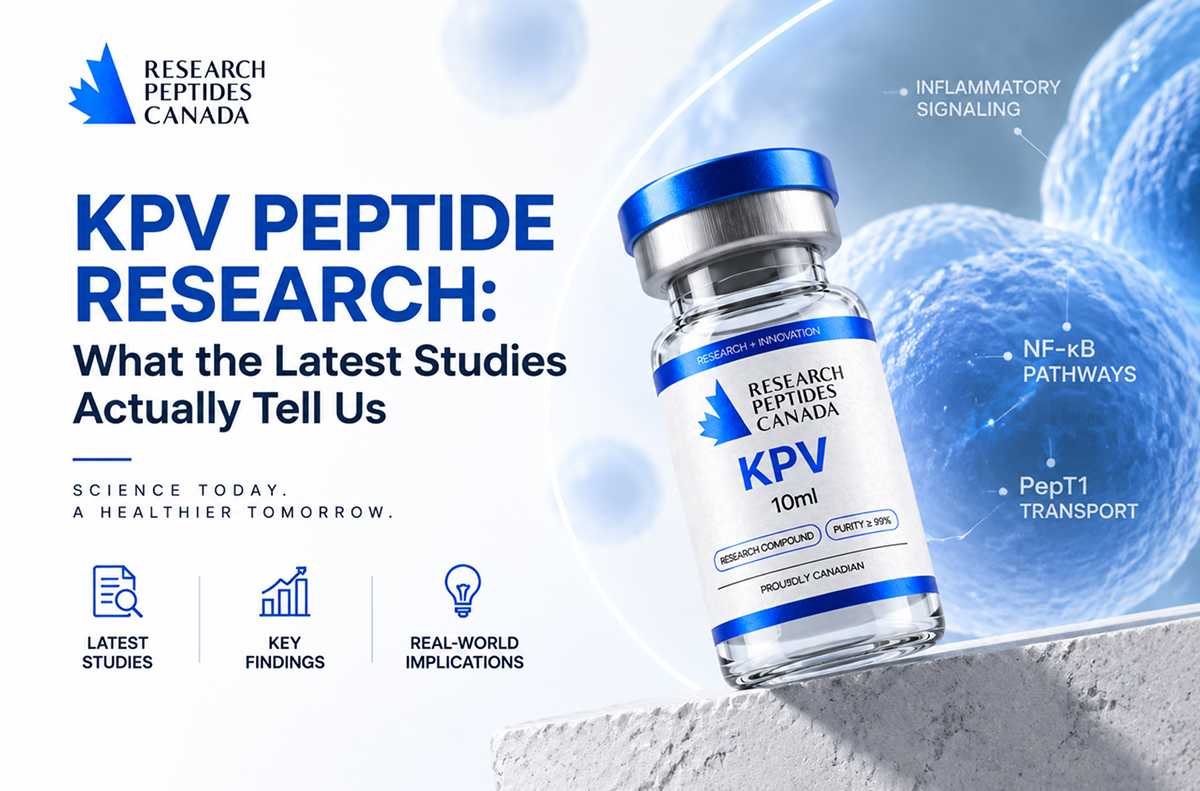


The field of KPV peptide research has grown from a niche area of inflammation biology into a broader investigation of how small peptide fragments can influence immune signaling.
KPV is a three-amino-acid peptide derived from the C-terminal region of alpha-melanocyte-stimulating hormone (α-MSH). Researchers became interested in KPV because studies suggested that this small fragment could retain anti-inflammatory activity without relying entirely on traditional melanocortin receptor pathways.
Current KPV research has focused mainly on:
- intestinal inflammation;
- epithelial barrier responses;
- cytokine regulation;
- skin inflammation;
- oxidative stress pathways.
However, the evidence remains primarily preclinical.
Most findings come from cell models and animal studies, while controlled human research is still limited.
If you are exploring peptide compounds for laboratory research, visit Research Peptides Canada to review research-use-only materials and available documentation.
Where Does KPV Peptide Research Stand Today?
Modern KPV peptide research began with the discovery that the final three amino acids of α-MSH could maintain biological activity independently.
α-MSH is part of the melanocortin peptide family, a group of molecules involved in pigmentation, immune regulation, and inflammatory signaling.
Researchers identified KPV as the sequence:
- Lysine (K);
- Proline (P);
- Valine (V).
Early studies suggested that KPV could reduce inflammatory responses even when classical melanocortin receptor pathways were blocked.
Getting and colleagues investigated KPV in experimental inflammation models and found that it reduced inflammatory cell recruitment and maintained activity in mice with impaired melanocortin-1 receptor signaling. This suggested that KPV may work through mechanisms different from full-length α-MSH (Getting et al., 2003, Journal of Endocrinology).
This discovery shaped much of the later research direction.
Instead of focusing on hormone-like activity, researchers began examining KPV as a potential regulator of inflammatory signaling.
Today, KPV research is mainly divided into several areas:
- intestinal inflammation and epithelial protection;
- immune-cell signaling;
- skin inflammation;
- oxidative stress responses;
- peptide delivery systems.
A major limitation remains that many studies investigate biological activity rather than clinical outcomes.
For researchers interested in exploring KPV further, learn more about KPV 10mg and its research applications.
What Does KPV Research Show About Inflammation and Gut Health?
One of the strongest areas of KPV research involves intestinal inflammation.
The gastrointestinal tract contains a complex immune environment where epithelial cells, immune cells, and microorganisms interact continuously.
When inflammatory pathways become overactivated, researchers investigate whether specific molecules can reduce excessive immune signaling while maintaining normal tissue function.
KPV has received attention because of its ability to influence inflammatory pathways involved in intestinal models.
A key study by Dalmasso and colleagues examined KPV in intestinal epithelial cells and animal models.
The researchers found that KPV reduced activation of NF-κB, decreased inflammatory cytokine production, and influenced signaling pathways associated with intestinal inflammation.
Importantly, the study demonstrated that PepT1, a peptide transporter expressed in intestinal epithelial cells, contributed to KPV uptake and activity (Dalmasso et al., 2008, Gastroenterology).
This finding provided a possible explanation for why KPV has been studied specifically in gut-related inflammation.
The proposed model is:
Inflammation increases PepT1 expression → KPV enters epithelial cells → inflammatory signaling decreases
Animal studies have provided additional evidence.
Kannengiesser and colleagues tested KPV in mouse models of inflammatory bowel disease and reported reductions in inflammatory markers, immune-cell infiltration, and disease severity.
The study also showed that these effects occurred independently of melanocortin receptor activation, supporting the idea that KPV functions through alternative pathways (Kannengiesser et al., 2008, Inflammatory Bowel Diseases).
However, researchers still need human studies to determine whether these findings translate into meaningful clinical effects.
What Have Studies Found About KPV and Skin Inflammation?
Another growing area of KPV peptide research involves skin biology.
Skin is an immune-active organ that responds to environmental stress, microbial exposure, and inflammatory triggers.
Researchers have investigated whether KPV can influence:
- inflammatory cytokines;
- oxidative stress;
- keratinocyte responses;
- barrier-related pathways.
Recent studies have expanded understanding of KPV beyond intestinal models.
A 2025 study examined KPV activity in human keratinocytes exposed to particulate matter-induced oxidative stress.
Researchers found that KPV reduced reactive oxygen species production and decreased inflammatory signaling involving MAPK and NF-κB pathways.
The study also reported protective effects in a three-dimensional skin model, suggesting that KPV may influence multiple layers of inflammatory response (KPV keratinocyte study, 2025).
These findings are important because oxidative stress is closely connected with skin inflammation.
Environmental stressors can activate inflammatory pathways that contribute to cellular damage.
By reducing oxidative signaling, KPV may represent a useful research tool for studying skin immune regulation.
However, researchers emphasize that laboratory activity does not automatically indicate effectiveness in humans.
Important questions remain:
- How effectively does KPV penetrate human skin?
- What concentrations reach target cells?
- How long does biological activity persist?
- Are observed effects clinically meaningful?
Delivery remains one of the major challenges in peptide research.
A study examining KPV skin delivery found that passive transport through skin barriers was limited, while technologies such as microneedles and iontophoresis improved peptide penetration (Babu et al., 2017).
This highlights an important principle:
A peptide’s biological activity depends not only on what it does in a laboratory model, but also on whether sufficient amounts reach the intended tissue.
What Have Recent KPV Studies Found in 2025 and 2026?
Recent KPV peptide research has moved toward understanding broader inflammatory and cellular responses.
Oxidative Stress and Cellular Protection
The 2025 keratinocyte study represents an important expansion of KPV research.
Rather than focusing only on cytokine suppression, researchers examined how KPV affects:
- reactive oxygen species;
- inflammatory cell signaling;
- cellular stress responses.
The findings suggested that KPV may influence inflammation through multiple connected pathways rather than a single molecular target.
Delivery and Formulation Research
Recent work has also focused on improving peptide delivery.
Because peptides can be unstable and may have limited absorption, researchers continue investigating:
- topical delivery systems;
- peptide stabilization methods;
- targeted transport approaches.
These studies are important because biological effectiveness depends heavily on exposure at the target site.
Human Research Development
The transition from laboratory models to human research remains the biggest step.
Currently, KPV research has not reached the same clinical development stage as approved peptide-based therapies.
Researchers still need controlled human studies examining:
- pharmacokinetics;
- absorption;
- safety;
- inflammatory biomarkers;
- long-term exposure.
For researchers interested in exploring KPV further, learn more about KPV 10mg and its research applications.
How Much Human Evidence Do We Have for KPV?
The current state of KPV peptide research is dominated by preclinical evidence.
Human evidence remains limited.
Researchers have demonstrated:
- biological activity in cell models;
- anti-inflammatory effects in animals;
- potential mechanisms involving NF-κB and peptide transport.
However, there is currently insufficient clinical evidence to confirm specific therapeutic effects in humans.
The U.S. FDA has noted that it has not identified clinical studies or human exposure data for KPV through relevant routes of administration and has highlighted unresolved questions regarding pharmacology, safety, and biological effects (U.S. FDA, 2026).
This means researchers still need to understand:
- how KPV behaves after administration;
- how long it remains active;
- whether laboratory concentrations are achievable in humans;
- whether animal findings translate clinically.
What About Research Dosing?
There is currently no validated human dosing guideline for KPV.
Experimental concentrations vary significantly depending on the model.
Examples include:
- cellular studies using laboratory concentrations;
- animal studies using controlled experimental exposure;
- delivery studies testing penetration methods.
These research parameters cannot be directly converted into human dosing because absorption, metabolism, and tissue exposure differ between experimental systems.
Learn more in our complete guide: KPV Peptide: What It Is and What Current Research Actually Shows.
FAQ About KPV Peptide Research
What is KPV peptide?
KPV is a three-amino-acid peptide derived from the C-terminal region of α-MSH.
What is the main area of KPV research?
The strongest research focus is inflammation biology, particularly intestinal inflammation and epithelial responses.
Does KPV research show anti-inflammatory effects?
Yes, multiple cell and animal studies have reported reduced inflammatory signaling. However, human evidence remains limited.
Has KPV been studied for skin biology?
Yes. Recent research has examined KPV in keratinocyte models and oxidative stress-related skin inflammation.
Does KPV work through melanocortin receptors?
Not entirely. Research suggests KPV can produce effects independently of classical melanocortin receptor signaling.
Has KPV been tested in clinical trials?
Currently, controlled human clinical evidence remains limited.
What is the biggest limitation of KPV research?
The main limitation is the gap between promising laboratory findings and confirmed human outcomes.
Overall, current KPV peptide research suggests that this small α-MSH-derived peptide may influence inflammatory signaling through multiple biological pathways.
The strongest evidence currently comes from intestinal inflammation models, epithelial studies, and emerging skin research.
However, researchers still need well-designed human studies to determine pharmacology, safety, and real-world biological relevance.
For laboratory-focused peptide research, visit Research Peptides Canada to explore research-use-only compounds and available documentation.
Disclaimer: The information and products discussed on this website are intended strictly for laboratory research and educational purposes only. They are not intended for human or veterinary use, diagnosis, treatment, prevention, or any form of clinical application.
3 Comments
I liked how this article focuses on what the current research actually shows rather than overstating the potential of KPV. The distinction between cell and animal studies and confirmed human outcomes is especially important when looking at experimental peptides.
The section on KPV and skin inflammation was particularly interesting to me. Seeing research connect KPV with oxidative stress, MAPK, and NF-κB makes the topic more complex than simply describing it as an anti-inflammatory peptide. I’d be interested to see how future studies address delivery and tissue exposure.
The discussion about the lack of validated human dosing was a useful point that I don’t see mentioned often. Experimental concentrations from cell or animal studies can’t simply be translated into human use, so more pharmacokinetic and safety research seems essential before drawing clinical conclusions.