
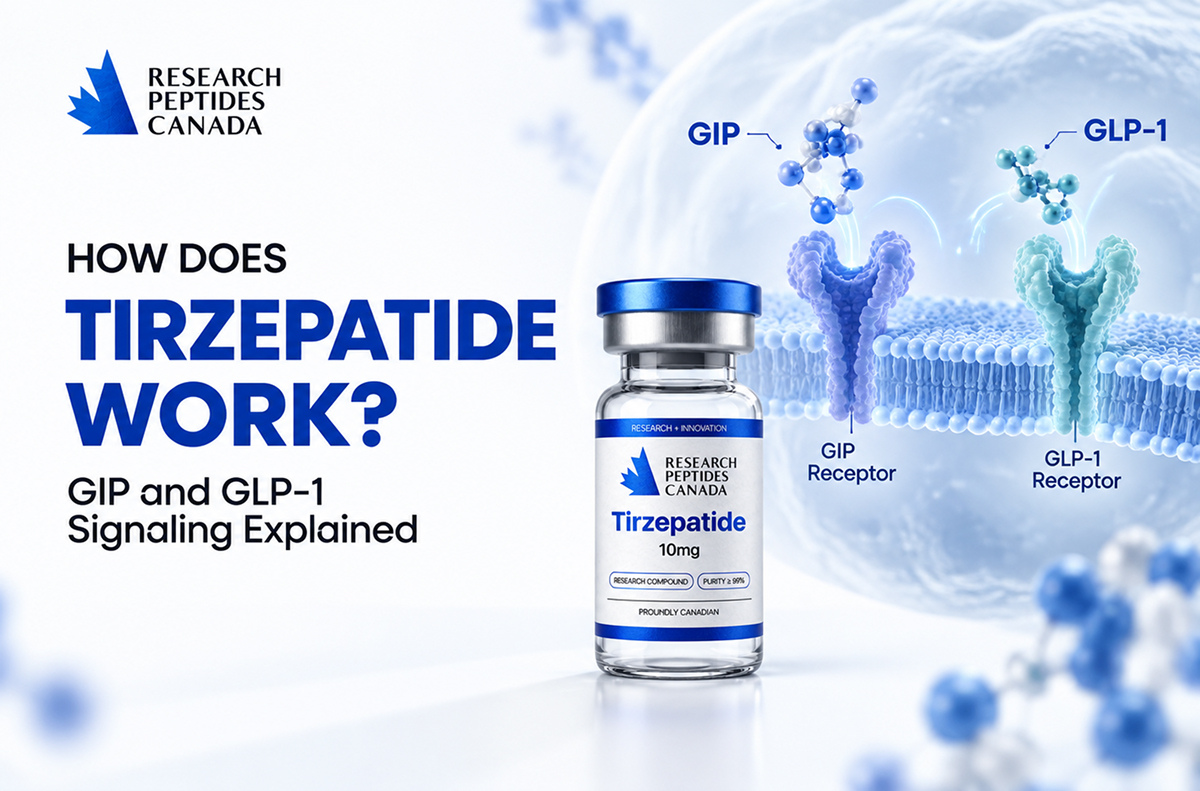


Understanding how does tirzepatide work requires looking at one of the most important developments in metabolic research: combining two incretin pathways into a single molecule.
Unlike traditional GLP-1 receptor agonists that primarily activate one pathway, tirzepatide is designed as a dual GIP and GLP-1 receptor agonist.
By stimulating both receptors, tirzepatide influences several interconnected biological processes, including:
- glucose-dependent insulin secretion;
- glucagon regulation;
- appetite signaling;
- gastric emptying;
- energy intake;
- metabolic adaptation.
Large clinical trials have demonstrated significant improvements in glucose control and body-weight reduction, but researchers are still studying how each receptor contributes to the overall effect.
If you are exploring metabolic peptides for laboratory research, visit Research Peptides Canada for research-use-only compounds and available documentation.
How Does Tirzepatide Work in the Body?
The simplest explanation of how does tirzepatide work is that it mimics two naturally occurring gut hormones:
- glucose-dependent insulinotropic polypeptide (GIP);
- glucagon-like peptide-1 (GLP-1).
These hormones belong to the incretin system.
Normally, when food enters the intestine, specialized cells release GIP and GLP-1. These signals communicate nutritional status to the pancreas, brain, stomach, and other tissues.
Tirzepatide is engineered to activate both incretin receptors:
Tirzepatide → GIP receptor activation + GLP-1 receptor activation → metabolic signaling changes
The result is a coordinated response involving:
- increased insulin release when glucose levels rise;
- reduced glucagon secretion;
- slower stomach emptying;
- altered appetite signaling;
- reduced energy intake.
The molecular structure of tirzepatide was designed to provide activity at both receptors while maintaining a prolonged duration of action suitable for once-weekly administration.
In the original pharmacological characterization study, Coskun and colleagues demonstrated that tirzepatide activated both GIP and GLP-1 receptors and produced metabolic effects in animal models, supporting the concept of dual incretin receptor agonism (Coskun et al., 2018, Molecular Metabolism).
This dual pathway is the foundation behind current research into tirzepatide’s metabolic effects.
Interested in exploring this compound further? Visit our Tirzepatide 10mg page for more research information.
How Does Tirzepatide Activate GIP and GLP-1 Receptors?
To understand how does tirzepatide work at the molecular level, it is important to examine the two receptor systems separately.
GLP-1 Receptor Signaling
The GLP-1 receptor is expressed in several tissues, including:
- pancreatic beta cells;
- brain regions involved in appetite regulation;
- gastrointestinal tissues.
When GLP-1 receptors are activated, signaling pathways increase glucose-dependent insulin secretion.
This means insulin release becomes stronger when blood glucose levels are elevated.
GLP-1 signaling also reduces glucagon secretion after meals and slows gastric emptying, contributing to reduced post-meal glucose excursions.
GIP Receptor Signaling
GIP was originally identified as an insulin-stimulating hormone.
The GIP receptor is found in:
- pancreatic beta cells;
- adipose tissue;
- the central nervous system;
- other metabolic tissues.
Research suggests GIP signaling may complement GLP-1 activity by improving insulin responsiveness and influencing energy metabolism.
The reason researchers became interested in dual agonism is that GIP and GLP-1 do not produce identical biological signals.
A preclinical study by Coskun et al. showed that tirzepatide produced stronger metabolic effects than activating either pathway alone in certain experimental models (Coskun et al., 2018, Molecular Metabolism).
However, exactly how much each receptor contributes in humans remains an active research question.
Some researchers propose that:
- GLP-1 signaling contributes strongly to appetite reduction;
- GIP signaling may improve insulin sensitivity and metabolic efficiency;
- combined activation creates a broader metabolic response.
How Does Tirzepatide Affect Appetite and Energy Intake?
One of the most visible effects of Tirzepatide in clinical research is reduced food intake and body-weight reduction.
This effect is closely linked to incretin signaling in the central nervous system.
GLP-1 receptors are expressed in brain regions involved in:
- hunger;
- reward processing;
- food motivation;
- energy balance.
Activation of these pathways can reduce appetite signals and increase feelings of fullness.
Tirzepatide also slows gastric emptying, meaning food moves more slowly from the stomach into the intestine.
This can contribute to:
- prolonged satiety;
- reduced meal size;
- lower overall calorie intake.
In the SURMOUNT-1 obesity trial, adults receiving tirzepatide experienced substantial weight reduction over 72 weeks compared with placebo. The highest dose group achieved an average reduction of approximately 20.9% of baseline body weight (Jastreboff et al., 2022, New England Journal of Medicine).
However, researchers continue investigating the exact mechanism behind weight loss.
Weight reduction is likely not caused by one single pathway.
Instead, it appears to involve a combination of:
- reduced appetite;
- lower energy intake;
- improved glucose metabolism;
- changes in fat storage and utilization.
Body-composition analysis from SURMOUNT-1 showed that most weight reduction came from fat mass, although some lean mass was also lost. Approximately 75% of total weight loss was attributed to fat mass reduction (Heymsfield et al., 2024, The Lancet Diabetes & Endocrinology).
Interested in exploring this compound further? Visit our Tirzepatide 10mg page for more research information.
How May Tirzepatide Influence Glucose and Insulin Regulation?
The metabolic foundation of how does tirzepatide work is its effect on glucose-dependent insulin regulation.
After meals, rising glucose levels stimulate GIP and GLP-1 signaling.
Tirzepatide enhances this incretin response by activating both receptors.
The main effects include:
Increased Insulin Secretion
Activation of GIP and GLP-1 receptors on pancreatic beta cells increases insulin release when glucose concentrations are elevated.
This glucose-dependent mechanism is important because it helps improve glucose control while reducing the risk of excessive insulin release during normal glucose conditions.
Reduced Glucagon Signaling
GLP-1 receptor activation suppresses inappropriate glucagon release.
Glucagon normally increases glucose production by the liver.
Reducing excessive glucagon activity can therefore improve glucose balance.
Improved Insulin Sensitivity
Over time, reductions in body weight and improved metabolic signaling can contribute to better insulin sensitivity.
The SURPASS clinical trial program demonstrated strong improvements in HbA1c among adults with type 2 diabetes.
In SURPASS-2, tirzepatide was compared with semaglutide 1 mg weekly. Tirzepatide produced greater reductions in HbA1c and body weight across studied doses (Frías et al., 2021, New England Journal of Medicine).
These results support the idea that dual incretin signaling produces meaningful metabolic changes beyond glucose reduction alone.
What Do Human Studies Tell Us About Tirzepatide’s Mechanism?
Human trials provide some of the strongest evidence explaining how does tirzepatide work.
Several large programs have examined different aspects of its mechanism.
SURPASS Trials: Diabetes and Glucose Control
The SURPASS clinical development program evaluated tirzepatide in adults with type 2 diabetes.
Across multiple Phase 3 studies, tirzepatide consistently improved:
- HbA1c;
- fasting glucose;
- body weight.
SURPASS-3 compared tirzepatide with insulin degludec in adults inadequately controlled on metformin. Tirzepatide produced greater reductions in HbA1c and body weight compared with basal insulin therapy (Ludvik et al., 2021, The Lancet).
SURMOUNT Trials: Obesity and Energy Balance
The SURMOUNT program examined tirzepatide in adults with obesity or overweight with weight-related conditions.
SURMOUNT-1 demonstrated substantial weight reduction without diabetes, supporting the role of appetite and energy-intake pathways in tirzepatide’s mechanism (Jastreboff et al., 2022, NEJM).
Long-Term Metabolic Questions
Researchers are continuing to investigate:
- durability after treatment withdrawal;
- cardiovascular outcomes;
- liver-fat changes;
- effects on metabolic inflammation.
The SURPASS-CVOT trial was designed to evaluate cardiovascular outcomes compared with dulaglutide in adults with type 2 diabetes and cardiovascular risk.
These outcome studies are important because metabolic improvements do not always automatically translate into long-term disease prevention.
What About Research Dosing?
Clinical trials have evaluated weekly doses ranging from 5 mg to 15 mg depending on the study population.
For example, SURMOUNT-1 investigated 5 mg, 10 mg, and 15 mg weekly doses over 72 weeks (Jastreboff et al., 2022, NEJM).
These values represent controlled clinical trial protocols and should not be interpreted as general dosing recommendations.
Learn more in our complete guide: What Is Tirzepatide? What Current Research and Clinical Evidence Show.
FAQ About How Tirzepatide Works
Is tirzepatide only a GLP-1 agonist?
No. Tirzepatide activates both:
- GIP receptors;
- GLP-1 receptors.
This dual mechanism distinguishes it from medications that primarily target GLP-1 alone.
Why does tirzepatide reduce appetite?
The main explanation involves incretin signaling in the brain and gastrointestinal system. GLP-1 receptor activation influences appetite-related pathways, while delayed gastric emptying may contribute to increased fullness.
Does tirzepatide directly burn fat?
Not directly. Weight reduction appears to result from multiple effects, including reduced energy intake, improved metabolic regulation, and changes in body composition.
Does tirzepatide increase insulin?
Yes, but in a glucose-dependent manner. Activation of GIP and GLP-1 receptors increases insulin secretion mainly when blood glucose levels are elevated.
How is tirzepatide different from semaglutide?
Semaglutide primarily activates GLP-1 receptors. Tirzepatide activates both GLP-1 and GIP receptors, creating a broader incretin signaling profile.
Clinical comparisons have shown greater average reductions in HbA1c and body weight with tirzepatide in certain populations (Frías et al., 2021, NEJM).
What is still unknown about tirzepatide’s mechanism?
Researchers are still studying:
- the exact contribution of GIP versus GLP-1 signaling;
- long-term metabolic effects;
- outcomes after discontinuation;
- potential applications beyond current indications.
Overall, understanding how does tirzepatide work requires viewing it as a coordinated metabolic signaling molecule rather than simply a weight-loss compound.
By activating both GIP and GLP-1 receptors, tirzepatide influences insulin regulation, appetite control, gastric function, and energy balance.
Human clinical trials have confirmed significant effects on glucose control and body weight, but researchers continue investigating the long-term biological consequences of dual incretin activation.
For laboratory-focused peptide research, visit Research Peptides Canada to explore research-use-only compounds and available documentation.
Disclaimer: The information and products discussed on this website are intended strictly for laboratory research and educational purposes only. They are not intended for human or veterinary use, diagnosis, treatment, prevention, or any form of clinical application.
3 Comments
I liked how this article explains tirzepatide beyond simply calling it a weight-loss peptide. The comparison between GIP and GLP-1 signaling was especially helpful, and I’m curious whether future research will clarify exactly how much each pathway contributes to the overall metabolic effects.
The section about appetite and energy intake was really interesting, especially the point that weight reduction likely involves several mechanisms rather than direct fat burning. The body-composition data also raises an important question about how researchers can better understand changes in lean mass during longer-term treatment.
This was a useful breakdown of why tirzepatide is different from a GLP-1-only approach. I also appreciated that the article pointed out what is still unknown, particularly the long-term effects and how outcomes may change after treatment is discontinued.