
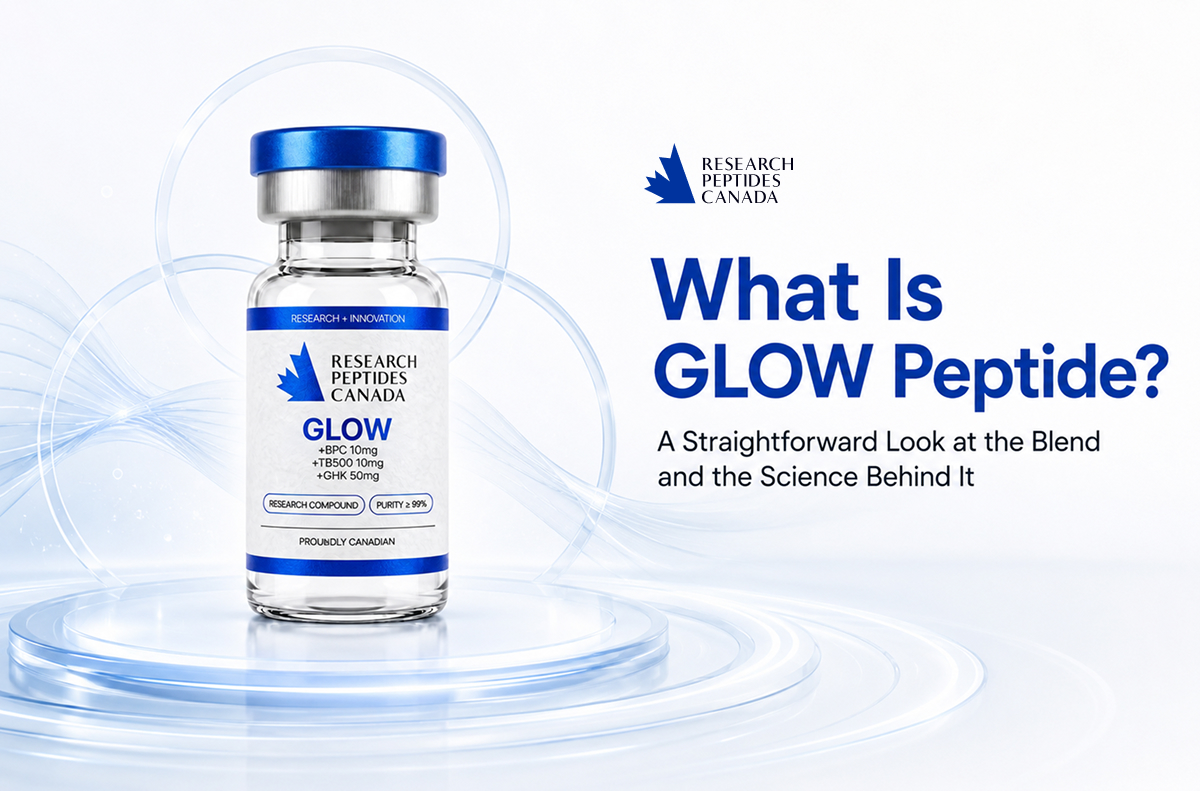


If you have seen the term GLOW online and wondered what is GLOW peptide, the simplest answer is this: GLOW is a research-market name commonly used for a combination of BPC-157, TB-500, and GHK-Cu. It is not one newly discovered peptide, and it does not have a single established clinical mechanism of its own.
That distinction matters because almost all published evidence comes from studies of the three ingredients separately. Some of that evidence is preclinical, some involves related molecules, and only a limited portion comes from human research.
For a straightforward starting point, explore Research Peptides Canada for research-use-only peptide materials and available product information. This article focuses on how to understand GLOW without turning three separate research literatures into one unsupported claim.
So, What Is GLOW Peptide?
When researchers or peptide suppliers use the name GLOW, they are generally referring to a combination containing:
- BPC-157
- TB-500
- GHK-Cu
If your question is what is GLOW peptide at the molecular level, there is no single molecular structure to draw. Instead, the name represents three chemically different research compounds combined into one formulation.
BPC-157 is a synthetic 15-amino-acid peptide studied mainly in preclinical models involving connective tissue, gastrointestinal biology, vascular responses, and inflammation. A 2025 HSS Journal review found that 35 of 36 BPC-157 musculoskeletal studies were preclinical, highlighting the field’s heavy reliance on animal and laboratory research. (Vasireddi et al., 2025, HSS Journal).
TB-500 requires a different qualification. Much of the research commonly associated with it actually involves full-length thymosin beta-4 rather than TB-500 itself. A 2026 scoping review by McGuire et al. in Applied Sciences examined 80 studies and found that 70 focused on thymosin beta-4, while direct TB-500 evidence represented only a very small part of the literature (McGuire et al., 2026, Applied Sciences)
GHK-Cu is a copper complex of the naturally occurring tripeptide glycyl-L-histidyl-L-lysine. Its research history centers more heavily on skin biology, collagen-related processes, extracellular-matrix signaling, and angiogenesis. A recent review noted that although GHK-Cu is widely used in topical products, its clinical, permeability, and physicochemical evidence remains less complete than its popularity might suggest (Mortazavi et al., 2025, BioImpacts).
So, a useful way to answer what is GLOW peptide is to think of it as a research combination—not a fourth peptide created when the three ingredients are mixed together.
Explore the GLOW Peptide Blend and review its research-use formulation and available product details.
What Is GLOW Peptide Supposed to Do?
The idea behind GLOW is that its three components may cover different areas of tissue-response biology.
Researchers usually associate BPC-157 with studies involving vascular signaling, fibroblast behavior, and connective tissue pathways. They discuss TB-500 alongside thymosin-related research focused on cell migration and extracellular matrix remodeling. GHK-Cu contributes another research area involving copper-dependent signaling, collagen regulation, fibroblast activity, and skin remodeling.
If researchers ask what GLOW peptide is supposed to do, the evidence-based answer is that it has no single proven effect. Instead, it is a research blend designed to investigate potentially complementary biological pathways together.
That hypothesis is important because complementary does not automatically mean synergistic.
A 2026 Achilles tendon study by Biçer et al. found that TB-500 improved selected biomechanical and histological outcomes, while combining it with BPC-157 showed no clear additional benefit. (Biçer et al., 2026, Joint Diseases and Related Surgery).
Because the study did not include GHK-Cu, it did not test GLOW directly. However, it shows that combining potentially complementary peptides does not necessarily produce greater effects.
How Could the Three Ingredients Affect Different Biological Pathways?
To understand what is GLOW peptide without repeating a full mechanism article, it helps to think of the formulation as three overlapping research lanes.
| Component | Main Research Area | Important Limitation |
|---|---|---|
| BPC-157 | Vascular and connective-tissue signaling | Human evidence remains limited |
| TB-500 | Cell migration and matrix remodeling | Much evidence comes from full-length Tβ4 |
| GHK-Cu | Collagen, fibroblasts, skin and matrix biology | Findings vary greatly by model and delivery system |
For BPC-157, the 2025 Vasireddi et al. systematic review summarized preclinical findings involving angiogenesis, growth-factor pathways, inflammatory signaling, and musculoskeletal repair. However, the authors emphasized that convincing human safety and efficacy evidence is still lacking (Vasireddi et al., 2025, HSS Journal).
For TB-500, the biological argument relies heavily on thymosin beta-4 literature. The 2026 McGuire et al. review mapped research involving wound healing, cellular migration, angiogenesis, and musculoskeletal repair while repeatedly emphasizing the small amount of direct TB-500 evidence (McGuire et al., 2026, Applied Sciences).
GHK-Cu occupies a somewhat different space. Research continues to investigate specialized delivery approaches because the peptide’s behavior can depend heavily on how it reaches the tissue being studied. A 2025 review by Ogórek et al. in Molecules described GHK-Cu as relatively hydrophilic and noted that transport through the skin, particularly when incorporated into liposomal systems, remains underexplored (Ogórek et al., 2025, Molecules).
If researchers ask what is GLOW peptide in practical research terms, they should view it as a formulation that combines separate biological research questions into a single experimental model rather than as evidence that researchers have already demonstrated all three mechanisms together.
Explore the GLOW Peptide Blend and review its research-use formulation and available product details.
What Does Published Research Actually Show?
This is where keeping an evidence hierarchy becomes useful.
As of August 2026, no controlled peer-reviewed human trials have evaluated the full three-component GLOW formulation. Current evidence comes from studies of its individual ingredients and one relevant BPC-157/TB-500 animal study.
For BPC-157, the 2025 systematic review by Vasireddi et al. found only one human clinical study among 36 papers included in its musculoskeletal analysis (Vasireddi et al., 2025, HSS Journal).
For TB-500, researchers reported more direct evidence in July 2026. In the Biçer et al. rat Achilles tendon study, researchers administered TB-500 at 60 µg/kg/day intraperitoneally for four weeks. Researchers reported a statistically significant increase in maximum load to failure compared with controls, alongside histological findings consistent with improved tendon architecture and extracellular-matrix organization (Biçer et al., 2026, Joint Diseases and Related Surgery).
GHK-Cu has a wider skin and extracellular-matrix literature, but the evidence varies substantially according to delivery system. The 2025 Mortazavi et al. review highlighted tissue-regeneration and collagen-related cellular findings while also pointing out the surprising shortage of strong clinical studies involving GHK-Cu itself (Mortazavi et al., 2025, BioImpacts).
How Should Dosing Information Be Interpreted?
People searching what is GLOW peptide often encounter dosing schedules at the same time. That is where research data are frequently taken out of context.
There is currently no validated human dosing schedule for the complete GLOW formulation.
For example, researchers administered 10 µg/kg/day of BPC-157 and 60 µg/kg/day of TB-500 to rats for four weeks in the 2026 Achilles tendon experiment. Researchers administered these study-specific animal doses intraperitoneally, and they should not interpret them as a human-use protocol.
GHK-Cu is harder to fit into a single dosing framework because studies use varied delivery methods, including topical and localized systems.
The U.S. FDA also notes that researchers have limited human safety information for BPC-157 and injectable GHK-Cu. For the thymosin beta-4 fragment known as TB-500, the agency states that it has not identified human exposure data and highlights potential concerns involving aggregation, immunogenicity, peptide-related impurities, and API characterization (U.S. FDA, 2026).
So a responsible answer to what is GLOW peptide dosing is that no validated clinical dosing guide currently exists for the three-component blend.
For a broader overview of the formulation, read our guide: GLOW Peptide: What It Is, How It Works, and What the Research Actually Shows.
What Do We Still Not Know About GLOW Peptide?
The biggest unknown is whether the full GLOW blend behaves differently from its individual ingredients.
Researchers still do not know:
- Whether the three compounds produce additive, overlapping, or opposing effects
- Which ingredient contributes most to the biological response
- Whether the blend has its own dose-response relationship
- How repeated exposure affects long-term safety
- Whether any effects are unique to the complete formulation
Researchers cannot simply combine individual study results to predict how the full blend will behave.
The evidence around TB-500 shows this problem clearly. A 2026 review noted that much of the research commonly associated with TB-500 actually involves full-length thymosin beta-4 rather than TB-500 itself.
The FDA has also highlighted limited or absent human safety information for several compounds and administration routes relevant to this research area (U.S. FDA, 2026).
GLOW peptide is a research blend of BPC-157, TB-500, and GHK-Cu designed around potentially overlapping tissue-response pathways, but it still lacks direct controlled human evidence.
When evaluating GLOW peptide, the most important distinction is between ingredient-level research, blend-level evidence, experimental dosing, and confirmed human data.evidence, blend-level evidence, experimental dosing, and human clinical evidence clearly separated.
Disclaimer: The information and products discussed on this website are intended strictly for laboratory research and educational purposes only. They are not intended for human or veterinary use, diagnosis, treatment, prevention, or any form of clinical application.
4 Comments
I really liked how this article explains that GLOW is a combination of three different research compounds rather than a completely new peptide. The distinction between ingredient-level research and evidence for the full blend was especially helpful. I’m curious whether future studies will evaluate all three ingredients together in a controlled model.
This was a great overview, especially the section explaining why complementary biological pathways don’t automatically mean a synergistic effect. I also found the limited direct evidence on the complete GLOW formulation interesting. Do you think researchers will eventually focus more on testing the blend itself rather than extrapolating from individual peptide studies?
I appreciate how carefully the article separates animal findings, related-compound research, and human evidence. The discussion about TB-500 being frequently associated with thymosin beta-4 research was particularly useful. It would be interesting to see whether more direct research on TB-500 and the complete GLOW blend changes the current evidence picture.