
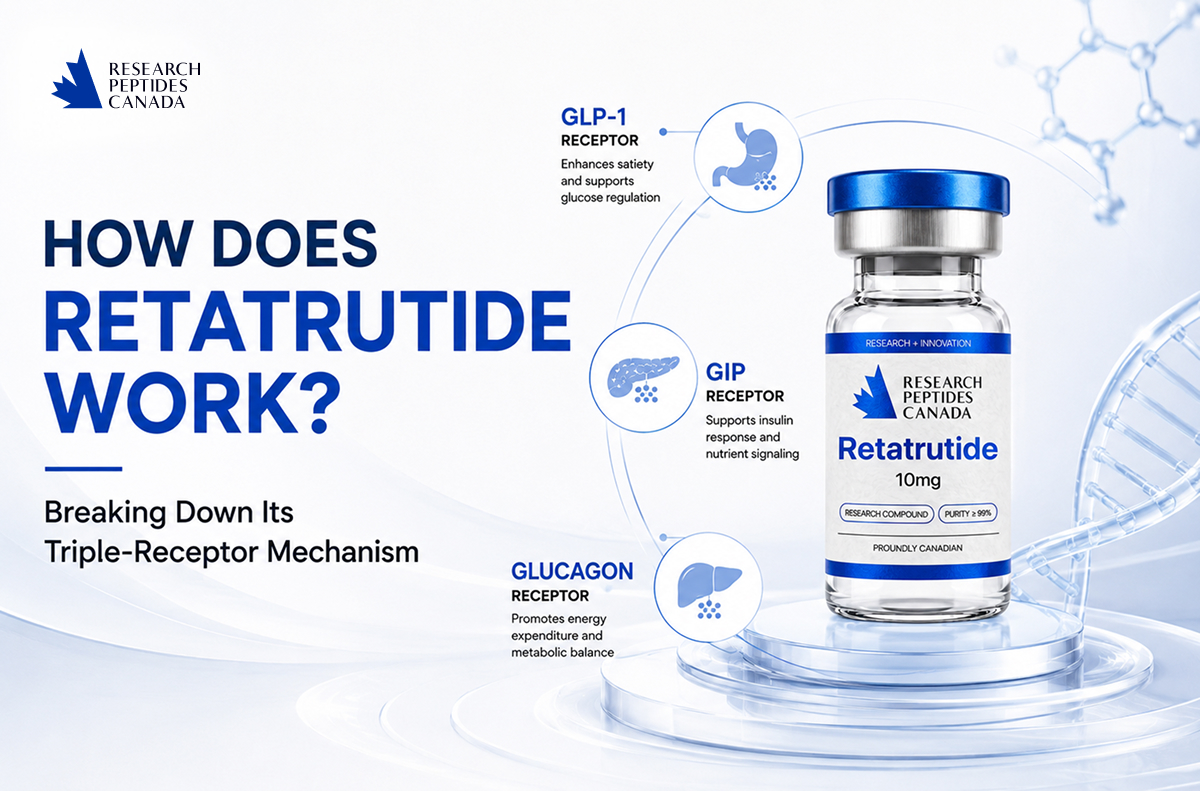


If you are asking how does retatrutide work, the short answer is that it does something unusual for a single peptide: it activates three metabolic hormone receptors at the same time—GLP-1, GIP, and glucagon receptors.
The more interesting answer is why those three pathways were combined.
GLP-1 and GIP signaling primarily influence food intake, insulin secretion, and glucose handling, while glucagon receptor activity may add effects on energy expenditure, substrate utilization, and liver metabolism. Retatrutide was engineered to bring those signals together in one molecule rather than administering three separate compounds.
For researchers evaluating metabolic peptides, explore Research Peptides Canada for research-use-only compounds and available product information. Understanding receptor pharmacology is particularly important with retatrutide because its biological activity cannot be explained by GLP-1 signaling alone.
What Makes Retatrutide a Triple Receptor Agonist?
The term triple receptor agonist means that one molecule can bind to and activate three different receptors.
Retatrutide, originally known as LY3437943, activates:
- the glucose-dependent insulinotropic polypeptide receptor (GIPR);
- the glucagon-like peptide-1 receptor (GLP-1R);
- the glucagon receptor (GCGR).
The foundational pharmacology was described by Coskun et al. in 2022 in Cell Metabolism. In laboratory receptor assays, retatrutide showed activity at all three targets. Its GIP receptor activity was comparatively stronger, while GLP-1 and glucagon receptor activity were more closely balanced. The researchers also showed in obese mouse models that adding glucagon-receptor activity increased energy expenditure on top of GIP- and GLP-1-related reductions in caloric intake. (PubMed)
That receptor profile is central to understanding how retatrutide works.
It is not simply “three weight-loss hormones added together.” Each receptor activates different intracellular and physiological processes, and the final effect depends on the relative strength of signaling at each target.
This receptor balance is also why retatrutide should not be treated as merely a stronger version of a single GLP-1 agonist.
For more research-focused information, explore our Retatrutide research peptide and review the available product details.
What Happens When Retatrutide Activates the GLP-1 Receptor?
GLP-1 is released naturally from intestinal cells after nutrient intake.
When the GLP-1 receptor is activated, several processes can occur:
- glucose-dependent insulin secretion increases;
- glucagon secretion can decrease when glucose is elevated;
- gastric emptying may slow;
- appetite and meal size can decline through central nervous system signaling.
For retatrutide, GLP-1 receptor activation provides an important part of the food-intake and glucose-control side of the mechanism.
That interpretation is consistent with early human research. In a 2022 Phase 1b study published in The Lancet, Urva and colleagues evaluated multiple weekly doses of LY3437943 in adults with type 2 diabetes. The study demonstrated improvements in glycemic measures and body weight over 12 weeks, providing early evidence that the receptor activity observed in preclinical experiments translated into measurable metabolic effects in humans. (PubMed)
However, GLP-1 activation alone does not fully answer how does retatrutide work.
If it did, there would be little reason to engineer GIP and glucagon activity into the same molecule. The triple-agonist concept is specifically designed to move beyond a single appetite-regulating pathway.
What Role Does GIP Signaling Play?
GIP is another nutrient-responsive incretin hormone.
After food intake, GIP can stimulate glucose-dependent insulin secretion through pancreatic beta cells. It also participates in nutrient handling and adipose-tissue biology.
Historically, GIP was sometimes viewed as an unusual target for metabolic treatment because people with type 2 diabetes can have impaired incretin responses. However, the development of dual and triple agonists changed how researchers think about GIP signaling.
Retatrutide was deliberately designed with relatively strong GIP receptor activity.
In the original Coskun et al. 2022 Cell Metabolism study, receptor assays showed greater activity at GIPR than at GLP-1R or GCGR. The authors proposed that GIP and GLP-1 receptor activity together contribute strongly to reduced food intake and improved glycemic control, while glucagon signaling adds another metabolic component. (PubMed)
So when considering how does retatrutide work, GIP should not be viewed as simply duplicating GLP-1.
The two incretin pathways may interact in ways that support insulin secretion, nutrient sensing, and appetite regulation while allowing glucagon receptor activity to be incorporated without necessarily producing uncontrolled hyperglycemia.
Exactly how much each receptor contributes in humans, however, remains difficult to isolate because retatrutide activates all three simultaneously.
Why Does Retatrutide Also Target the Glucagon Receptor?
This is arguably the most distinctive part of retatrutide’s design.
Glucagon is often introduced simply as the hormone that raises blood glucose. That description is correct but incomplete.
Glucagon signaling also affects:
- hepatic nutrient metabolism;
- amino-acid metabolism;
- lipid oxidation;
- satiety;
- substrate utilization;
- energy expenditure.
The hypothesis behind retatrutide is that controlled glucagon receptor agonism may increase metabolic energy use while GLP-1 and GIP signaling help control food intake and glucose regulation.
In the 2022 Coskun et al. preclinical experiments, glucagon receptor activity increased energy expenditure in obese mice, adding to the reduction in food intake associated with GIP and GLP-1 pathways. (ScienceDirect)
Importantly, direct proof that the same degree of glucagon-driven energy expenditure occurs in humans treated with retatrutide is still incomplete.
However, evidence from other GLP-1/glucagon co-agonist research supports the underlying concept. A randomized metabolic-ward study of the GLP-1/glucagon agonist SAR425899 found reduced metabolic adaptation and greater fat oxidation compared with placebo under calorie restriction, although 24-hour energy expenditure itself was not significantly increased. (PubMed)
This distinction matters. When explaining how does retatrutide work, researchers should say that glucagon-mediated energy expenditure is strongly supported by retatrutide’s preclinical development but remains harder to quantify directly in humans.
For more research-focused information, explore our Retatrutide research peptide and review the available product details.
How Could These Three Pathways Work Together?
The triple-receptor concept can be simplified into two broad sides of energy balance:
| Receptor Pathway | Proposed Contribution |
|---|---|
| GLP-1 | Appetite regulation, gastric effects, glucose-dependent insulin signaling |
| GIP | Insulin signaling, nutrient handling, interaction with GLP-1 pathways |
| Glucagon | Energy expenditure, substrate oxidation, hepatic and lipid metabolism |
In reality, these systems overlap extensively.
The important idea is that retatrutide may influence both sides of the energy-balance equation: how much energy enters the system through food intake and how energy is subsequently handled or expended.
This helps explain why the question how does retatrutide work cannot be answered with “appetite suppression” alone.
Human metabolic studies provide several indirect signals that this broader model is plausible.
In a 2024 Phase 2a substudy published in Nature Medicine, Sanyal and colleagues examined 98 participants with metabolic dysfunction-associated steatotic liver disease. At 24 weeks, liver-fat reductions reached 81.4% with 8 mg and 82.4% with 12 mg, while placebo showed essentially no reduction. Changes in liver fat were associated with changes in weight, abdominal adiposity, insulin sensitivity, and lipid metabolism. (PubMed)
Those results do not prove that glucagon receptor activation alone caused the liver effects. Weight reduction itself can substantially reduce liver fat. Nevertheless, the findings demonstrate that retatrutide’s metabolic effects extend beyond scale weight.
Similarly, a 2025 body-composition substudy by Coskun et al. in The Lancet Diabetes & Endocrinology found significant reductions in total fat mass in adults with type 2 diabetes. At week 36, total fat mass declined by 15.2% with pooled 4 mg treatment, 26.1% with pooled 8 mg treatment, and 23.2% with 12 mg. The proportion of lean-mass loss relative to total weight loss was comparable with other obesity treatments. (PubMed)
These findings help move the discussion of how does retatrutide work from receptor theory toward measurable changes in human metabolic tissues.
For a broader overview of the compound, read our guide: Retatrutide Peptide: How It Works, What the Research Shows, and What We Know So Far
What Does Current Research Tell Us About Retatrutide’s Mechanism in Humans?
Human trials confirm that retatrutide produces metabolic effects consistent with its intended receptor design, but they cannot yet tell us exactly what percentage of the response comes from GLP-1, GIP, or glucagon signaling.
The 2023 Phase 2 obesity trial by Jastreboff et al. in the New England Journal of Medicine demonstrated strong dose-dependent body-weight reductions and improvements in waist circumference, blood pressure, glucose, insulin, and lipid measures. The investigators specifically discussed the possibility that glucagon-receptor activation could add effects on substrate utilization and energy expenditure to the appetite-related effects of GIP and GLP-1 signaling. (New England Journal of Medicine)
More recently, Bajaj et al. published the Phase 3 TRANSCEND-T2D-1 trial in The Lancet in June 2026. In adults with type 2 diabetes, once-weekly retatrutide produced significant improvements in HbA1c and body weight compared with placebo. Mean HbA1c reductions reached 1.94 percentage points with 12 mg, while body weight fell by 15.3% over 40 weeks. Importantly, no severe hypoglycemia was reported. (PubMed)
That finding is mechanistically relevant: glucagon receptor activation is capable of increasing hepatic glucose output, yet the combined molecule still produced substantial glycemic improvement in people with type 2 diabetes. This supports the idea that receptor balance, rather than any one pathway in isolation, is central to how does retatrutide work.
Why Do Retatrutide Studies Use Dose Escalation?
Clinical trials have generally used gradual dose escalation rather than starting participants immediately at higher maintenance doses.
For example, the Phase 2 program examined doses ranging from 0.5 mg to 12 mg weekly, with some groups beginning at lower doses before escalation. The 2023 obesity trial found that gastrointestinal adverse effects were dose-related and could be partially reduced by using a lower starting dose. (New England Journal of Medicine))
This does not establish a personal-use dosing guide. Instead, it shows that receptor activation and tolerability are dose-dependent, which is relevant when interpreting mechanism studies.
So, how does retatrutide work based on the evidence available in August 2026?
The strongest model is that GLP-1 and GIP signaling reduce energy intake and support glucose regulation, while glucagon-receptor activation adds effects involving energy expenditure, substrate utilization, and hepatic metabolism. Human trials clearly confirm powerful downstream metabolic effects, but researchers still need studies specifically designed to isolate how much each receptor contributes.
For laboratory-focused research materials, visit Research Peptides Canada. When evaluating retatrutide research, it is especially important to distinguish proven human metabolic outcomes from receptor-specific mechanisms that are still being investigated.
Disclaimer: The information and products discussed on this website are intended strictly for laboratory research and educational purposes only. They are not intended for human or veterinary use, diagnosis, treatment, prevention, or any form of clinical application.
4 Comments
This was a very clear explanation of retatrutide’s three-receptor mechanism, especially the way GLP-1, GIP, and glucagon activity are presented separately. I found the explanation of how these pathways may interact particularly interesting. Do you think future research will be able to determine which pathway contributes most to the overall effects?
I really appreciated how the article explains the difference between receptor activation and the actual outcomes observed in clinical research. It makes the science much easier to follow without oversimplifying the mechanism. I’d be interested to see whether longer-term studies reveal any changes in the balance between these three pathways.
The section explaining retatrutide as a triple agonist was probably the most useful part for me. I like that the article focuses on the underlying research rather than presenting the mechanism as proof of a particular outcome. Are researchers currently learning more about how glucagon activity complements the GLP-1 and GIP pathways?