
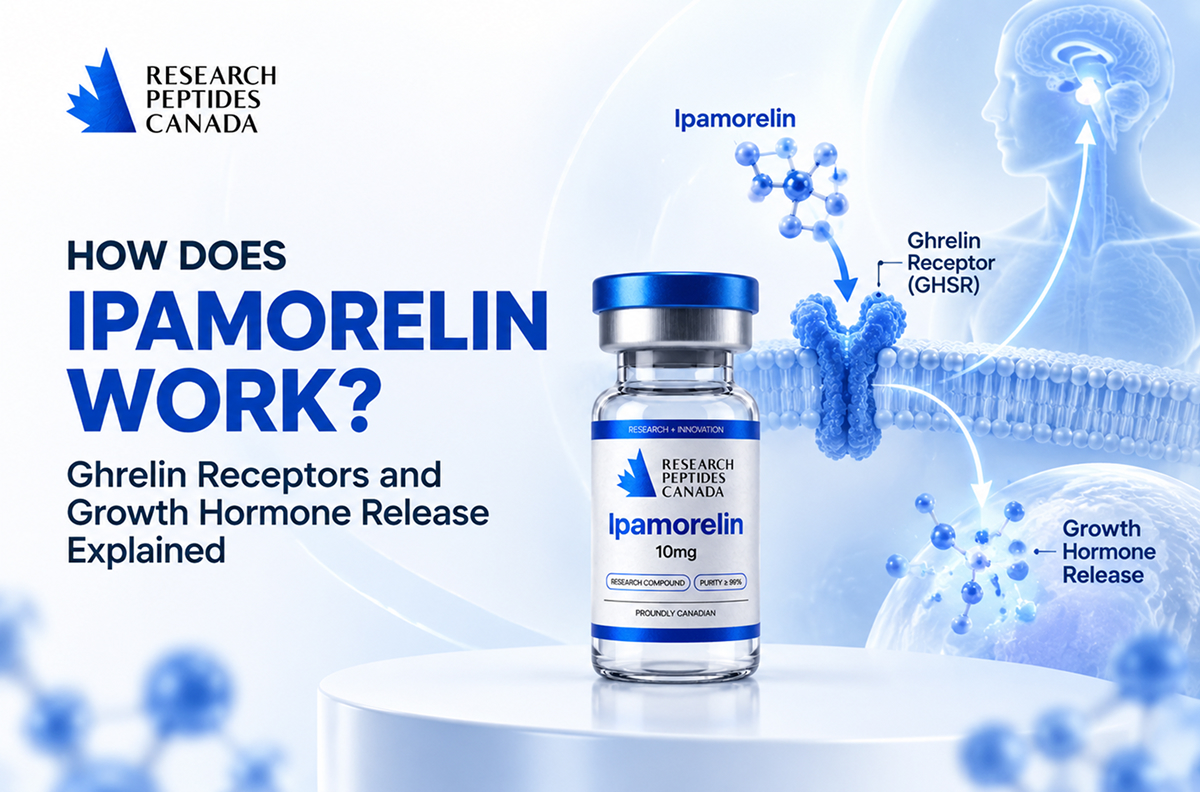


Understanding how does ipamorelin work starts with a different question: instead of replacing growth hormone (GH), how can a molecule encourage the body to release its own GH?
Ipamorelin belongs to a class of compounds called growth hormone secretagogues (GHSs). These compounds stimulate GH release by activating the growth hormone secretagogue receptor type 1a (GHS-R1a), also known as the ghrelin receptor.
Unlike growth hormone itself, ipamorelin does not directly provide GH. Instead, it acts as a signaling molecule that influences the pituitary gland.
The proposed pathway is: Ipamorelin → GHS-R1a activation → pituitary somatotroph stimulation → growth hormone release → downstream GH/IGF-1 signaling
Research into ipamorelin has focused primarily on receptor pharmacology, GH secretion patterns, and how selective activation of this pathway differs from older secretagogues.
If you are exploring peptide compounds for laboratory research, visit Research Peptides Canada for research-use-only compounds and available documentation.
How Does Ipamorelin Work in the Body?
The biological mechanism behind how does ipamorelin work involves the body’s natural growth hormone regulation system.
Growth hormone release is controlled by several signals originating from the hypothalamus and peripheral tissues.
The major regulators include:
- growth hormone-releasing hormone (GHRH), which stimulates GH release;
- somatostatin, which suppresses GH secretion;
- ghrelin, a stomach-derived hormone that stimulates GH release through GHS-R1a.
Ipamorelin mimics part of the ghrelin signaling pathway.
When ipamorelin binds to GHS-R1a receptors on pituitary somatotroph cells, it initiates intracellular signaling that promotes GH secretion.
The released GH then acts on tissues throughout the body and stimulates production of insulin-like growth factor-1 (IGF-1), mainly from the liver.
This creates the broader endocrine pathway:
GHS-R1a activation → GH secretion → IGF-1 signaling
The original pharmacological studies that characterized ipamorelin demonstrated that it stimulated GH secretion in animal models while showing a more selective hormonal profile compared with earlier growth hormone secretagogues (Raun et al., 1998, European Journal of Endocrinology).
This selectivity became the defining feature of ipamorelin research.
Interested in learning more about this peptide? Explore our Ipamorelin 10mg research product for additional information.
How Does Ipamorelin Activate the Ghrelin Receptor?
The key to how does ipamorelin work is its interaction with the ghrelin receptor.
GHS-R1a is a G protein-coupled receptor (GPCR) expressed in several tissues, including:
- pituitary gland;
- hypothalamus;
- brain regions involved in energy regulation;
- peripheral tissues.
When ipamorelin binds to GHS-R1a, the receptor activates intracellular signaling pathways.
Although the complete signaling network remains complex, ghrelin receptor activation generally involves:
- receptor binding;
- activation of G-protein signaling;
- increased intracellular calcium availability;
- stimulation of hormone secretion.
In pituitary cells, this signaling promotes release of stored growth hormone.
Research into ghrelin receptor biology has shown that GHS-R1a activation plays a central role in regulating GH secretion and energy-related signaling.
A review by Kojima and Kangawa described ghrelin as the endogenous ligand for GHS-R1a and established the receptor as a major regulator of GH secretion (Kojima & Kangawa, 2005, Physiological Reviews).
Ipamorelin uses this same receptor system but was designed to provide a more targeted pharmacological effect.
This receptor-level activity separates ipamorelin from compounds that act through the GHRH receptor, such as tesamorelin.
Although both can increase GH release, they stimulate different biological entry points.
How Does Ipamorelin Stimulate Growth Hormone Release?
The central mechanism of how does ipamorelin work is stimulation of pituitary GH secretion.
The pituitary contains specialized cells called somatotrophs that store and release GH.
When GHS-R1a is activated by ipamorelin, signaling pathways inside these cells increase the likelihood of GH release.
Unlike direct GH administration, secretagogues work by encouraging the body’s own endocrine system to produce hormone pulses.
This is scientifically important because natural GH secretion is not constant.
GH is normally released in pulses, with some of the largest secretion occurring during deep sleep.
Research suggests that stimulating endogenous GH release can produce a pattern closer to physiological secretion compared with continuous hormone exposure.
In early animal research, ipamorelin demonstrated strong GH-releasing activity.
Raun and colleagues compared ipamorelin with other growth hormone secretagogues and found that it produced significant GH stimulation while showing minimal effects on prolactin and cortisol secretion (Raun et al., 1998, European Journal of Endocrinology).
This finding contributed to interest in ipamorelin as a selective GH secretagogue.
However, increasing GH release does not automatically translate into specific clinical outcomes.
GH affects multiple systems, including:
- metabolism;
- glucose regulation;
- tissue signaling;
- body composition.
Therefore, researchers must evaluate both hormone changes and downstream biological effects.
How Selective Is Ipamorelin Compared With Other GH Secretagogues?
One of the most studied aspects of how does ipamorelin work is its selectivity compared with earlier growth hormone secretagogues.
Older compounds such as:
- GHRP-2;
- GHRP-6;
- hexarelin;
also activate GHS-R1a but may influence additional hormonal pathways.
For example, some earlier secretagogues have been associated with increases in:
- prolactin;
- adrenocorticotropic hormone (ACTH);
- cortisol.
Ipamorelin was developed with the goal of achieving stronger GH selectivity.
In pharmacological studies, ipamorelin stimulated GH secretion while producing fewer effects on other pituitary hormones compared with GHRP-6.
The original researchers described ipamorelin as a highly selective GH secretagogue because of its limited activity outside GH regulation (Raun et al., 1998, European Journal of Endocrinology).
However, selectivity does not mean complete specificity.
GHS-R1a is involved in broader physiological processes, including appetite regulation and energy balance.
The ghrelin receptor itself has multiple functions beyond GH release.
Researchers continue investigating how different patterns of receptor activation influence outcomes in different tissues.
Interested in learning more about this peptide? Explore our Ipamorelin 10mg research product for additional information.
What Do Human Studies Tell Us About Ipamorelin’s Mechanism?
Human research provides important confirmation that ipamorelin can stimulate GH release, but the available evidence remains limited compared with larger clinical programs involving approved endocrine therapies.
Early human pharmacology studies focused mainly on measuring GH response.
A Phase 1 clinical study evaluated intravenous ipamorelin administration in healthy volunteers and demonstrated dose-related increases in GH secretion, confirming biological activity in humans (Janssen et al., 1998, Journal of Clinical Endocrinology & Metabolism).
These studies helped establish:
- receptor activity in humans;
- GH release patterns;
- short-term pharmacological effects.
However, they were not designed to prove long-term clinical benefits.
Important unanswered questions remain:
- How does repeated GHS-R1a stimulation affect endocrine balance?
- How does ipamorelin influence IGF-1 over extended periods?
- Are effects different between healthy individuals and people with GH deficiency?
- What are the long-term metabolic consequences?
Another important consideration is that GH signaling is complex.
Increasing GH can influence:
- insulin sensitivity;
- glucose metabolism;
- lipid metabolism.
Therefore, researchers need to examine broader physiological effects rather than only measuring GH increases.
What About Research Dosing?
Published ipamorelin doses vary significantly depending on study design.
Early human studies investigated controlled intravenous administration to evaluate pharmacokinetics and GH response rather than establish a general dosing protocol (Janssen et al., 1998, Journal of Clinical Endocrinology & Metabolism).
Animal studies have used different experimental amounts depending on the research model.
These values describe laboratory conditions and should not be converted directly into human-use schedules.
There is currently no universally established therapeutic dosing guideline for ipamorelin outside approved medical applications.
Learn more in our complete guide: What Is Ipamorelin? What Current Research Actually Shows.
FAQ About How Ipamorelin Works
Does ipamorelin increase growth hormone?
Yes. Ipamorelin stimulates growth hormone release by activating the GHS-R1a receptor on pituitary cells.
Is ipamorelin the same as growth hormone?
No. Ipamorelin is a secretagogue, meaning it encourages endogenous GH release. It does not directly provide growth hormone.
Does ipamorelin act on the ghrelin receptor?
Yes. The primary target of ipamorelin is GHS-R1a, also known as the ghrelin receptor.
How is ipamorelin different from tesamorelin?
The mechanisms are different. Tesamorelin activates the GHRH receptor pathway. Ipamorelin activates the ghrelin receptor pathway. Both can influence GH secretion but through different biological signals.
Does ipamorelin increase IGF-1?
Because GH stimulates IGF-1 production, increased GH signaling may influence IGF-1 levels.
However, the magnitude depends on factors such as dose, duration, age, and individual physiology.
Is ipamorelin approved for human use?
No. Although ipamorelin has been studied in laboratory and early human research, it does not have broad regulatory approval as a therapeutic treatment.
What is the biggest limitation of ipamorelin research?
The biggest limitation is the lack of long-term controlled human outcome data. Current evidence shows that ipamorelin can stimulate GH release, but researchers still need more information about safety, clinical applications, and long-term effects.
Overall, understanding how does ipamorelin work requires focusing on its role as a selective ghrelin receptor agonist.
Current research shows that ipamorelin activates GHS-R1a, stimulates pituitary growth hormone release, and produces a more selective GH secretagogue profile compared with earlier compounds.
However, the biological effects of increasing GH signaling are complex, and many potential applications remain investigational.
For laboratory-focused peptide research, visit Research Peptides Canada to explore research-use-only compounds and available documentation.
Disclaimer: The information and products discussed on this website are intended strictly for laboratory research and educational purposes only. They are not intended for human or veterinary use, diagnosis, treatment, prevention, or any form of clinical application.
3 Comments
I really liked how this article breaks down the GHS-R1a pathway without making the mechanism sound overly complicated. The distinction between stimulating the body’s own GH release and directly providing GH was especially helpful. I’d be interested to see more research on how this signaling behaves with repeated exposure.
The comparison between ipamorelin and older secretagogues like GHRP-6 was really interesting. I didn’t realize that selectivity refers more to the hormonal profile rather than meaning the compound only affects one pathway. More long-term human data would definitely make this topic easier to understand.
I appreciated that the article didn’t stop at explaining how ipamorelin can increase GH, but also pointed out that higher GH doesn’t automatically mean a specific clinical benefit. The section on the limited long-term human evidence was a good reminder of how much there is still to learn about this peptide.