
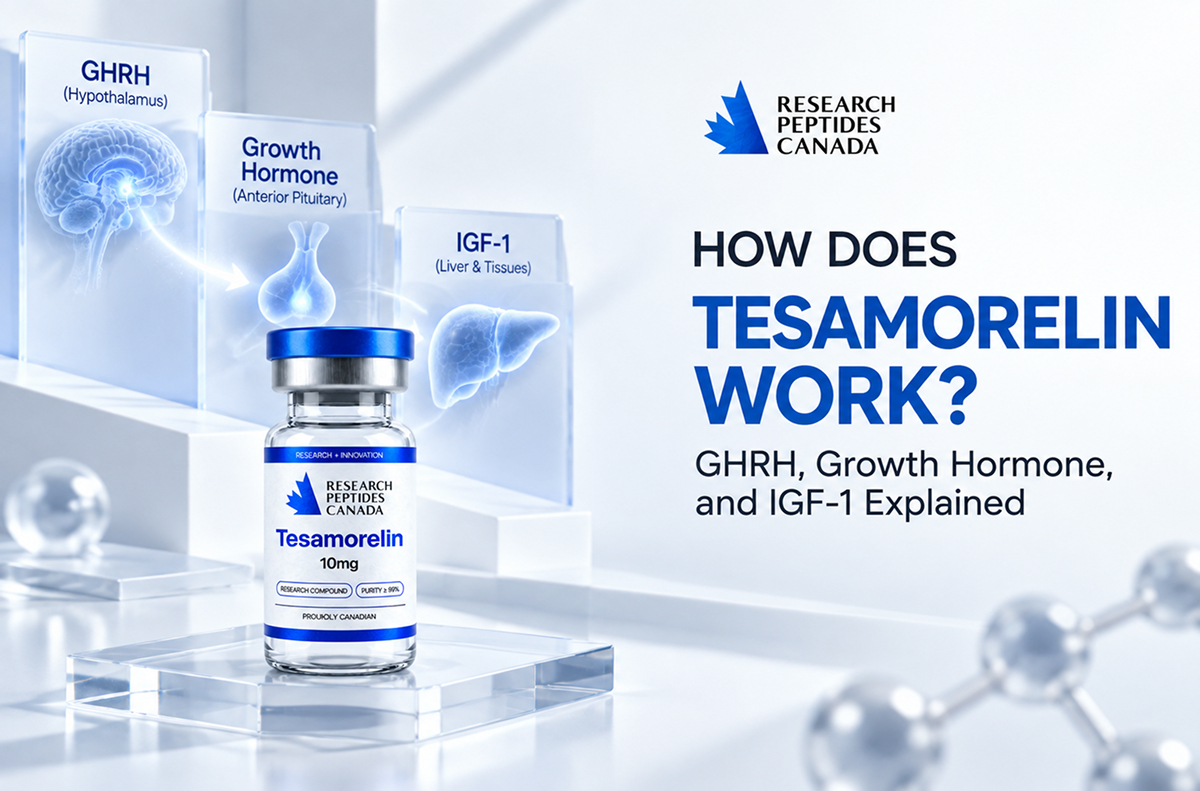


If you want to understand how does tesamorelin work, the most important point is that tesamorelin is not growth hormone itself. Instead, it acts one step earlier in the endocrine pathway by stimulating the growth hormone-releasing hormone (GHRH) receptor in the pituitary gland.
That signal promotes endogenous growth hormone (GH) secretion, which then affects downstream insulin-like growth factor-1 (IGF-1) and metabolic pathways. Human clinical research has connected this mechanism particularly strongly with changes in visceral adipose tissue (VAT) in adults with HIV-associated lipodystrophy.
The pathway can be simplified as: Tesamorelin → GHRH receptor → pituitary GH secretion → IGF-1 and peripheral GH signaling → metabolic effects
If you are investigating GH-axis compounds in laboratory settings, visit Research Peptides Canada to explore research-use-only peptides and available analytical documentation.
How Does Tesamorelin Work in the Body?
To understand how does tesamorelin work, it helps to begin with the normal hypothalamic-pituitary growth hormone axis.
The hypothalamus naturally releases GHRH. This hormone travels to the anterior pituitary, where it binds GHRH receptors on specialized cells called somatotrophs.
Those cells subsequently release GH.
Tesamorelin is a synthetic 44-amino-acid analog of human GHRH. Its sequence contains a modification at the N-terminus that makes it more resistant to enzymatic degradation than endogenous GHRH.
Instead of supplying GH directly, tesamorelin mimics the upstream GHRH signal.
Current FDA prescribing information describes its pharmacodynamic action as stimulation of GH synthesis and secretion through GHRH receptor activation, followed by increases in IGF-1 (U.S. FDA, current EGRIFTA WR prescribing information).
That distinction matters.
Direct administration of exogenous GH bypasses hypothalamic GHRH signaling. Tesamorelin instead works through an existing regulatory pathway at the pituitary.
This makes the compound useful for studying how controlled stimulation of the endogenous GH axis influences metabolism.
Interested in exploring this peptide further? Visit our Tesamorelin 10mg page for more research information.
How Does Tesamorelin Activate the GHRH Receptor?
The GHRH receptor belongs to the family of G protein-coupled receptors (GPCRs).
These receptors sit in the cell membrane and convert extracellular signals into intracellular responses.
When tesamorelin binds the GHRH receptor on pituitary somatotroph cells, receptor activation stimulates intracellular signaling involving adenylyl cyclase and cyclic AMP (cAMP).
The downstream cascade promotes both synthesis and secretion of GH.
Conceptually, the sequence looks like this: Tesamorelin → GHRH receptor → G-protein signaling → adenylyl cyclase → cAMP → GH synthesis and secretion
This mechanism distinguishes tesamorelin from growth hormone secretagogues that target other receptors.
For example, ipamorelin stimulates the growth hormone secretagogue receptor GHS-R1a, commonly called the ghrelin receptor. Tesamorelin instead directly targets the GHRH receptor.
The two pathways can both influence GH secretion, but they should not be treated as biologically interchangeable.
Earlier endocrine research demonstrated that GHRH stimulation can preserve the physiological regulation of endogenous GH secretion rather than simply replacing circulating GH (Mayo et al., GHRH receptor physiology, Endocrine Reviews).
This receptor-level mechanism is the foundation for understanding the metabolic findings observed in later tesamorelin trials.
How Does Tesamorelin Affect Growth Hormone and IGF-1?
Once the pituitary receives the GHRH signal, it releases GH into circulation.
Growth hormone then interacts with GH receptors in multiple tissues, including:
- liver;
- adipose tissue;
- skeletal muscle;
- bone.
One important downstream response occurs in the liver, where GH signaling stimulates production of IGF-1.
This gives us the second major part of how does tesamorelin work: GHRH receptor stimulation → increased endogenous GH → increased IGF-1
Human clinical trials demonstrate this response clearly.
In pooled Phase 3 data from more than 800 adults with HIV-associated abdominal fat accumulation, treatment produced substantial increases in IGF-1 alongside reductions in visceral adipose tissue (Falutz et al., 2010, Journal of Clinical Endocrinology & Metabolism).
IGF-1 therefore functions as an important pharmacodynamic marker showing that the GH axis has been activated.
However, more IGF-1 is not automatically better.
Because persistent elevations in IGF-1 may have biological consequences, current prescribing information recommends monitoring IGF-1 during approved treatment and considering discontinuation when concentrations remain substantially elevated (U.S. FDA, EGRIFTA prescribing information).
This is an important part of the mechanism that simplistic descriptions of tesamorelin sometimes overlook.
The compound does not selectively activate “fat loss.” It modifies an endocrine signaling axis with effects across multiple tissues.
How May Tesamorelin Influence Visceral Fat and Metabolism?
The relationship between GH signaling and adipose tissue provides the clearest explanation for tesamorelin’s effects on visceral fat.
Growth hormone has lipolytic activity, meaning that it can promote breakdown of stored triglycerides in adipocytes and alter lipid metabolism.
But clinical findings suggest that the response is not distributed equally across every fat compartment.
Visceral adipose tissue appears particularly responsive.
In a randomized trial involving 412 adults with HIV and abdominal fat accumulation, 26 weeks of treatment reduced visceral adipose tissue by approximately 15%, while placebo participants experienced an increase. Triglycerides and the total-cholesterol-to-HDL ratio also improved (Falutz et al., 2007, New England Journal of Medicine).
A pooled analysis of Phase 3 trials subsequently reported approximately 15.4% less VAT relative to placebo after 26 weeks, without a comparable reduction in abdominal subcutaneous adipose tissue (Falutz et al., 2010, Journal of Clinical Endocrinology & Metabolism).
This provides an important clue about how tesamorelin works.
Its clinical effect is not simply generalized weight reduction.
Current FDA labeling specifically states that the approved product has a weight-neutral effect and is not indicated for weight-loss management (U.S. FDA, current prescribing information).
Researchers have also investigated liver fat.
A randomized study found reductions in both VAT and hepatic lipid after six months of treatment (Stanley et al., 2014, JAMA).
Later research in adults with HIV and non-alcoholic fatty liver disease found that 12 months of treatment produced a significantly greater reduction in hepatic fat than placebo (Stanley et al., 2019, The Lancet HIV).
These results suggest that GH-axis stimulation may influence lipid storage in more than one metabolically active tissue compartment.
Interested in exploring this peptide further? Visit our Tesamorelin 10mg page for more research information.
What Do Human Studies Tell Us About Tesamorelin’s Mechanism?
Human trials provide a useful advantage when studying how does tesamorelin work because researchers can compare hormonal changes with changes in body composition.
Several patterns repeatedly appear.
IGF-1 Rises as Visceral Fat Falls
Phase 3 studies consistently found increased IGF-1 alongside reductions in VAT. This supports the proposed sequence from GHRH receptor activation to downstream metabolic effects (Falutz et al., 2010).
The Effect Depends on Continued Pathway Stimulation
Researchers have also examined what happens when treatment stops.
In extension research, participants who continued treatment generally maintained VAT reductions, whereas participants switched from active treatment to placebo regained substantial amounts of visceral fat (Falutz et al., 2008, Journal of Clinical Endocrinology & Metabolism).
This suggests that the effect does not permanently reprogram adipose tissue.
Instead, continued stimulation of the GHRH–GH axis appears necessary to maintain much of the observed response.
Metabolic Effects Are More Complex Than Fat Reduction
Growth hormone can influence glucose metabolism as well as lipolysis.
Current FDA labeling therefore includes warnings concerning glucose intolerance or diabetes and recommends evaluating glucose status during prescribed treatment (U.S. FDA, EGRIFTA prescribing information).
This demonstrates why how does tesamorelin work cannot be reduced to “it increases GH and burns fat.”
It changes an endocrine pathway with interconnected effects on adipose tissue, IGF-1, glucose regulation, and other physiological systems.
What Doses Have Mechanistic Studies Used?
Many pivotal clinical trials used 2 mg subcutaneously once daily of the original formulation.
Current approved formulations use different doses because their concentrations and pharmacokinetic characteristics differ. Current FDA labeling should therefore be used for prescription-product dosing rather than attempting to transfer older study doses between formulations (U.S. FDA, current EGRIFTA prescribing information).
Clinical-trial doses describe controlled study conditions and should not be treated as instructions for unapproved peptide use.
Learn more in our complete guide: What Is Tesamorelin? What Current Research and Clinical Evidence Show.
FAQ About How Tesamorelin Works
Does tesamorelin contain growth hormone?
No. Tesamorelin activates the GHRH receptor and stimulates the pituitary to release endogenous GH. It does not contain GH itself.
Does tesamorelin increase IGF-1?
Yes. Human clinical trials consistently show increased IGF-1 following treatment, confirming downstream activation of the GH–IGF-1 axis (Falutz et al., 2010).
How does tesamorelin differ from ipamorelin?
They target different receptors. Tesamorelin activates the GHRH receptor, whereas ipamorelin primarily acts through GHS-R1a, the ghrelin receptor. Both can stimulate endogenous GH secretion through different upstream mechanisms.
Why does tesamorelin affect visceral fat?
The leading explanation involves GH-mediated lipolysis and changes in lipid metabolism. Human trials demonstrate significant VAT reductions, although the precise reason visceral fat responds more strongly than subcutaneous fat remains an area of research.
Does tesamorelin cause general weight loss?
Not necessarily. Its established clinical effect is reduction of excess abdominal visceral fat in adults with HIV-associated lipodystrophy, rather than generalized weight loss. FDA labeling describes the treatment as weight neutral overall.
Does the effect continue after treatment stops?
Evidence suggests much of the visceral-fat benefit can reverse after discontinuation. This supports the idea that continued GHRH pathway stimulation contributes to maintaining the response (Falutz et al., 2008).
Overall, the evidence gives researchers a relatively clear picture of how does tesamorelin work: it activates pituitary GHRH receptors, stimulates endogenous GH secretion, increases downstream IGF-1, and influences lipid metabolism in ways that can preferentially reduce visceral adipose tissue.
Unlike many experimental peptides, this mechanism is supported by randomized human trials. At the same time, GH–IGF-1 signaling affects multiple biological systems, meaning the mechanism cannot be separated from considerations involving glucose regulation, IGF-1 exposure, and other endocrine effects.
For laboratory-focused peptide research, visit Research Peptides Canada to explore research-use-only compounds and available analytical documentation.
Disclaimer: The information and products discussed on this website are intended strictly for laboratory research and educational purposes only. They are not intended for human or veterinary use, diagnosis, treatment, prevention, or any form of clinical application.
3 Comments
I really liked how clearly this article explains the GHRH–GH–IGF-1 pathway. The distinction between tesamorelin stimulating endogenous GH release and directly providing growth hormone was especially helpful. I’m curious whether future research will clarify why visceral fat appears to respond more strongly than subcutaneous fat.
This was a great explanation of how tesamorelin activates the GHRH receptor rather than the ghrelin receptor targeted by compounds like ipamorelin. I found the comparison between the two pathways particularly easy to understand. Do you think studying both pathways together could provide more insight into endogenous GH regulation?
I appreciated that the article goes beyond simply saying tesamorelin “increases growth hormone” and explains the downstream metabolic effects as well. The discussion about visceral fat returning after treatment stops was particularly interesting. It raises an important question about how continued pathway stimulation influences the long-term response.